Purposeful Innovation: Avoiding Single-Vendor Lock-in Risk with Andrew Campbell, CIO at Terex Corporation
Andrew talks with us about a number of topics, including the concept of purposeful innovation at Terex, the drawbacks to single-vendor environments, his reasons for being a servant leader, and more.

Andrew Campbell
Terex CIO
Purposeful Innovation: Avoiding Single-Vendor Lock-in Risk with Andrew Campbell, CIO at Terex Corporation
Andrew talks with us about a number of topics, including the concept of purposeful innovation at Terex, the drawbacks to single-vendor environments, his reasons for being a servant leader, and more.
1:00 Working in IT at Xerox & GE
2:17 Your job is everyone's hobby
6:50 The drawbacks of single vendor environments
9:17 Terex's Innovation Council
12:25 Servant leadership
15:57 Hunter Muller & HMG Strategy
17:50 Advice from John Repko
18:39 What drives you?
“I always try and remind my peers that the competition is outside the company, not inside the company.”
Andrew Campbell
Terex CIO
Andrew Campbell on Purposeful Innovation, Servant Leadership, and Why Your Job Is Everybody's Hobby
Andrew Campbell, CIO, Terex Corporation | Interviewed by Luke Alie of Atolio
Andrew Campbell is the CIO at Terex Corporation, a manufacturer of industrial equipment including tower cranes, crushers, and boom lifts. He previously held CIO roles at Xerox and GE. In this conversation he talks about the concept of purposeful innovation, what servant leadership actually looks like in practice, why he embraces shadow IT rather than fighting it, and what drives him most at this point in his career.
IT at the Intersection of Technology and Heavy Manufacturing
Luke Alie (LA): You've worked across manufacturing, printing, security systems, and more. What is it like now being at the intersection of IT and heavy industrial equipment?
Andrew Campbell (AC): Across all of these industries, the IT organizations I joined typically were not considered part of the product itself. But that's changing. We now introduce a great deal of technology into our equipment that requires what I call a heartbeat. You don't just send a crusher or a concrete mixer out to a job site. It goes out and talks back to you continuously. That's where IT skills come in to bridge the gap between engineering and products with a live digital presence.
Your Job Is Everybody's Hobby: Embracing Technical Peers Outside IT
LA: You've said your job is everybody's hobby. What do you mean by that?
AC: I can't take credit for the phrase, but it was said to me: remember that your job is everybody's hobby because technology is everywhere. My business partners, customers, and suppliers do have technology skills. If we as an IT organization don't acknowledge that, we'll be seen as pushing things on people: use this tool, do it this way. Instead, I say: they already understand how they want to automate a process. How do we help them get there? Maybe they can't access a data source because it belongs to another department. We can help bridge that. The question isn't whether business partners have technology skills. It's how do we make those skills even stronger.
Shadow IT: Letting Innovation Breathe Before Standardizing
LA: What's your perspective on shadow IT? Is that even a valid term?
AC: I don't get too worked up about it. Certain skunkworks experimentation I actually think is healthy. The challenge is when a business partner feels that bringing IT in will slow them down, only to find later that they need an integration they can't build or a solution that isn't sustainable. So I caution our business leaders early: almost nothing you do today doesn't have a technology implication. Let's have the conversation at the beginning so we can actually be helpful to each other.
But I have never been someone who feels the need to control everything. If a small innovative group is working on something, let it run. When we learn about it, we figure out whether we can help accelerate it or whether they are heading in the wrong direction we can help them navigate out of. Shadow IT is going to exist. Sometimes it will be a good thing. Sometimes it will need cleanup. And you move on.
Purposeful Innovation: Pulling the Concept Out of the Science Fiction Drawer
LA: Tell me about Terex's Innovation Council and the concept of purposeful innovation.
AC: It started with four people: our CEO, CFO, chief strategy officer, and me. As we grew in understanding how we were supporting different innovation efforts, we realized we were not doing new-science innovation. We are not splitting atoms. We are going after purposeful innovation. That's the label we put on it.
Purposeful innovation can mean taking something that's already been done in another industry and applying it to ours. Just changing the language made a big difference. It became less scary: if I don't invent something brand new, I am still innovating. And from a CFO and CEO perspective, it became less about spending money on things with no clear payoff. Once you shape innovation around a clear question, what does this do for the customer? What does this do for safety in our factories? What does this do for our team members? the whole organization gains confidence in the concept.
Here's a concrete example: we sell concrete mixers. We now have what we call a digital technician on board. A customer has something going wrong with the truck. They call us, we can see the machine via FaceTime or a connected system, diagnose remotely, and either walk them through a fix or make sure the field technician arrives with exactly the right parts. That's purposeful innovation. It's not magic. It's connectivity, fault codes, and remote diagnostics applied to a real customer problem.
Servant Leadership: Getting Out of the Way So Others Can Succeed
LA: You describe your leadership style as servant leadership. What does that mean to you?
AC: When I joined Terex, servant leadership was in the company values, and the description rang completely true to me. My role is to make sure everybody else has what they need to be successful in their role. That also means getting out of their way if I am in the way.
I've never been a top-down leader. I don't tell people: you do this, you do that. Instead: this is what we need to achieve collectively. Here are our roles. Run with it. Ask for help when you need it. And I remind people constantly that the competition is outside the company, not inside it. We have to be better together to beat the competition. Stepping on a peer to look taller is not a strategy I have ever had patience for.
My leadership style developed through a combination of my father's example from when I was a kid, and then seeing a range of leaders throughout my career. Some demonstrated this style and their teams were happy and successful. Others didn't, and the contrast was clear. It was a bit through osmosis.
What Drives Andrew Campbell Now
LA: What's the best question I haven't asked you?
AC: What drives me. Early in my career, I wanted to make a name for myself, though I didn't fully understand what that meant. So I worked hard, raised my hand for difficult projects, and put in long hours. What drives me now is the success of the people around me, at work, in my family, in my community. And that has grown to include things I care deeply about, like diversity, equity, and inclusion. It starts with uncomfortable conversations. The uncomfortable conversations are how things actually change.
LA: Andrew, thank you so much for coming on the show.
AC: Take care.
Latest Episodes
Green Computing and Data Unlocking: Mentorship for Tech Leaders with Andrea Gallego, Global CTO at BCG GAMMA
Andrea Gallego (Global CTO at BCG GAMMA) has taken her career from large financial institutions, to rapidly growing NGOs, and ultimately to this intersection of consulting and tech. Listen in to hear her thoughts on the value of mentorships between women, how she became interested in startup culture, possible new ways to leverage information at consulting groups, and more.
Internal Knowledge Management: Experimentation While Scaling with Paolo Negri, Co-founder at Contentful
Paolo walks us through his early career at startups across Europe, how he built a company solving a problem he faced at those very startups, why he encourages a culture based on experimentation at Contentful, and much more.
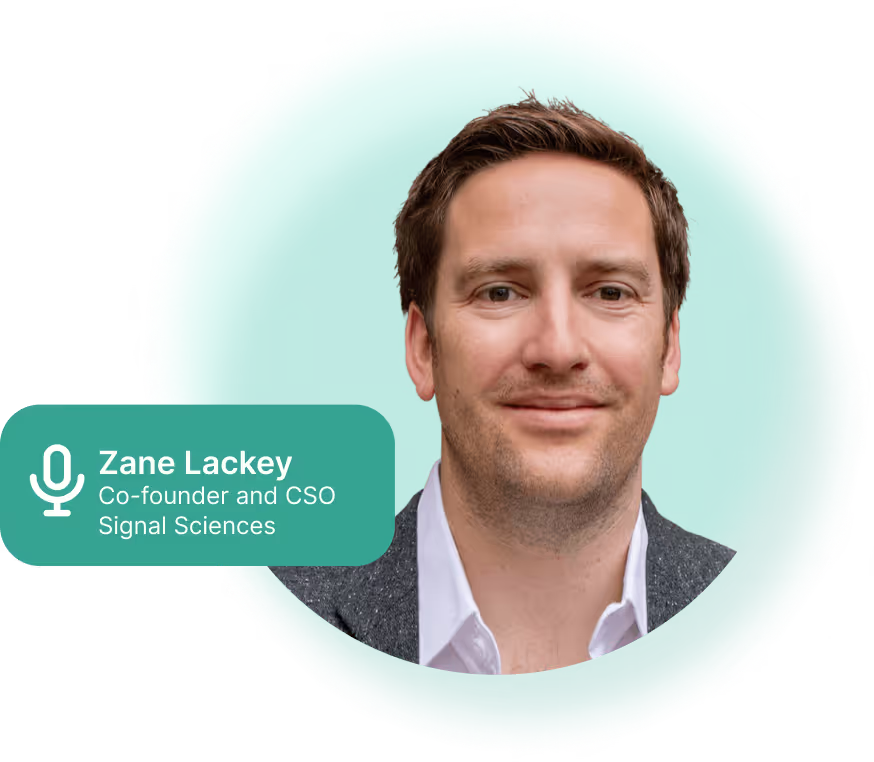
Securing Digital Transformation: Practical Lessons from Signal Sciences with Zane Lackey, Co-founder at Signal Sciences
Zane is a Co-founder and Chief Security Officer at Signal Sciences, a web-application security company acquired by Fastly. Zane shares what his career has taught him about security, founding teams, and what the future holds for digital transformations.
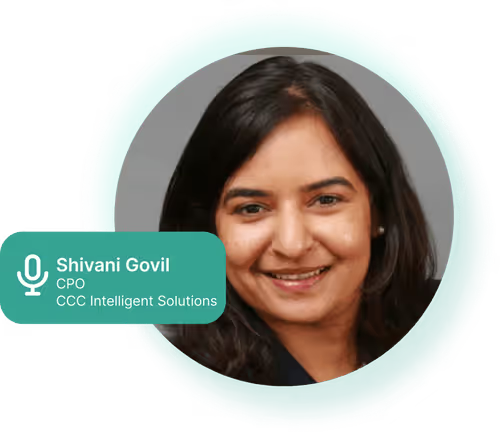
Innovation Culture: Enterprise vs. Startup Technology Scaling with Shivani Govil, CPO at CCC Intelligent Solutions
Innovation has been a central focus in Shivani Govil's career, including during her time at Silicon Valley Startups, SAP, and in her current role as Chief Product Officer at CCC Intelligent Solutions, a modern insurance solutions company. We dove into how she thinks innovation works at different scales, business units, industries, and more.
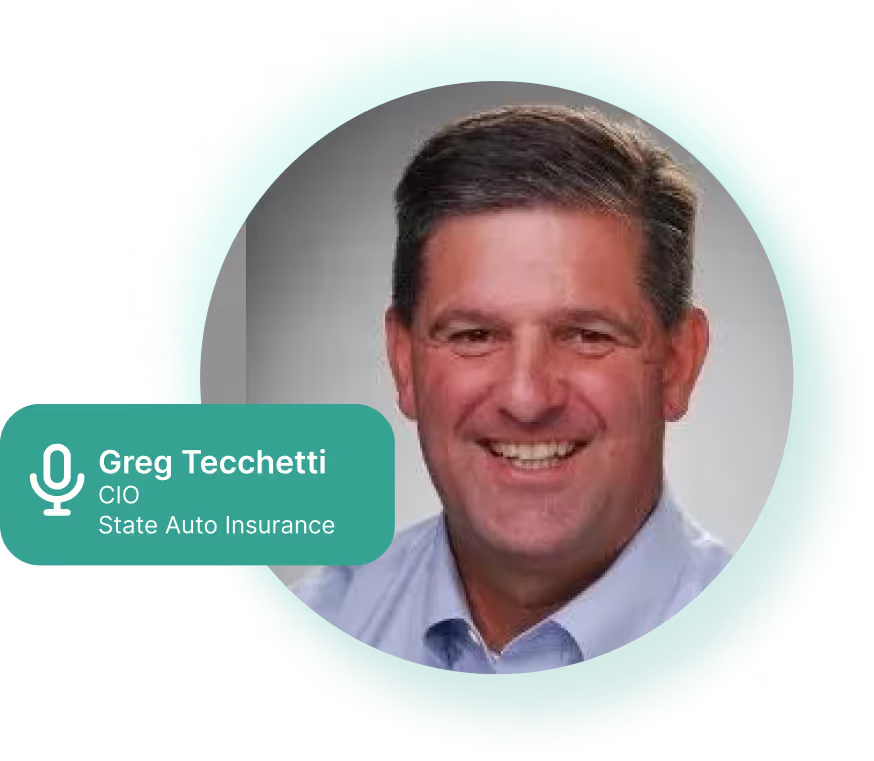
Startup to Enterprise Ops: Lessons for Serial Entrepreneurs with Greg Tacchetti, CIO at State Auto Insurance
Atolio's co-founder Mark Matta interviews Greg Tacchetti, CIO at State Auto Insurance. Greg shares his story, what he learned from his previous experience as a co-founder, which tech he's most excited about these days, and more.

SaaS Sprawl and Transparency: Scaling Internal Employee Directories with Alex Solomon, CTO and Co-founder at PagerDuty
Alex Solomon (CTO & Co-founder at PagerDuty) joins us to talk about the early days at PD and some critical decisions about transparency, documentation, employee experience, and more.
Engineering Transparency: Building a Culture of Urgency (Without Panic) with Steve Zerby, CIO at Owens Corning
Fortune 500 CIO Steve Zerby talks with us about the culture of urgency that he is helping foster at Owens Corning and how it relates to ego, transparency, service, and more.
CIO Leadership Advice: Lessons from Sales and Go-to-Market with Julie Cullivan, Former Forescout CIO
Julie (Board Director at Axon, HeartFlow, and AaDya) joins us to share how she handled leading both technology & people at Forescout, why she took the leap to become a first-time CIO at FireEye, what she learned from her go-to-market roles at McAfee & Autodesk, and more.
CIO to CPTO Transition: Shaping Product Culture and Curiosity with Ramin Beheshti, CPTO at Dow Jones
Ramin is the Chief Product & Technology Officer at Dow Jones, publisher of The Wall Street Journal, Barrons, Marketwatch, and more. He talks leadership lessons, the value of curiosity, his approach to working with startups, and more.
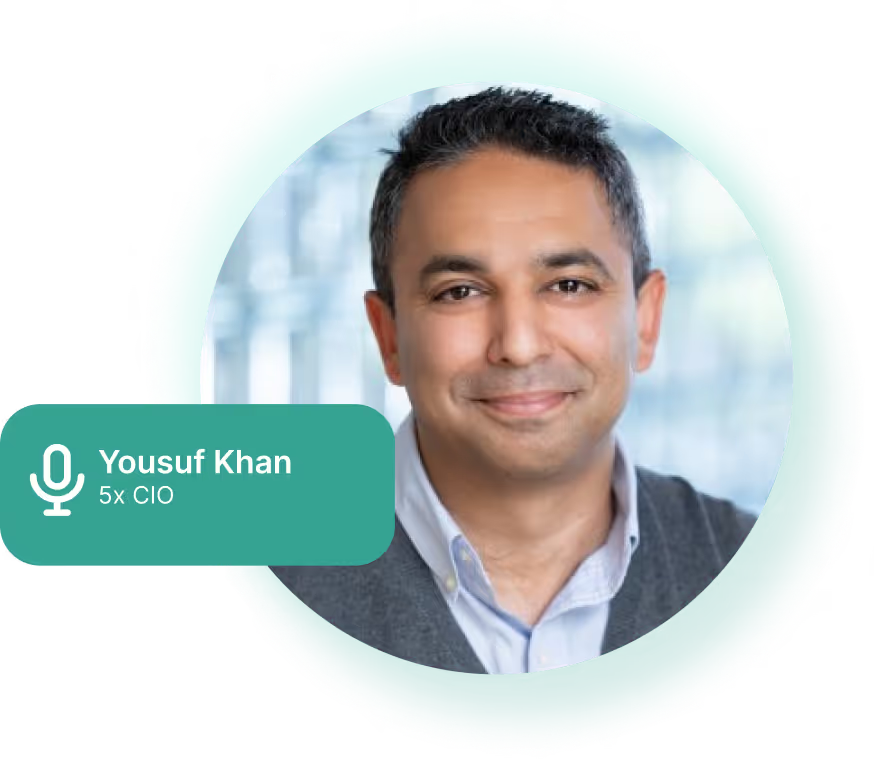
CIO to VC: Evaluating Startup Tech and Early-Stage Bets with Yousuf Khan, Former 5x CIO
Our first guest is Yousuf Khan, who discusses what he learned on his journey from accidental CIO at companies like Automation Anywhere, Moveworks, and Pure Storage to unconventional VC at Ridge Ventures.