Innovation Culture: Enterprise vs. Startup Technology Scaling with Shivani Govil, CPO at CCC Intelligent Solutions
Innovation has been a central focus in Shivani Govil's career, including during her time at Silicon Valley Startups, SAP, and in her current role as Chief Product Officer at CCC Intelligent Solutions, a modern insurance solutions company. We dove into how she thinks innovation works at different scales, business units, industries, and more.

Shivani Govil
CCC Intelligent Solutions CPO
Innovation Culture: Enterprise vs. Startup Technology Scaling with Shivani Govil, CPO at CCC Intelligent Solutions
Innovation has been a central focus in Shivani Govil's career, including during her time at Silicon Valley Startups, SAP, and in her current role as Chief Product Officer at CCC Intelligent Solutions, a modern insurance solutions company. We dove into how she thinks innovation works at different scales, business units, industries, and more.
1:18 Shivani’s background
3:28 How do you choose which startups to partner with?
7:10 How has your idea of innovation changed?
11:05 Innovating at different scales
17:30 Competing for experiences
18:14 Which new tech is the most exciting?
21:26 Fostering a culture of innovation
“Technology is opening new frontiers, layered with the fact that customers have new appetites for how they want to engage. ”
Shivani Govil
CCC Intelligent Solutions CPO
Shivani Govil on Innovation at Every Scale, Partnering with Startups, and Building Cultures Where Failure Is Just a Learning Moment
Shivani Govil, CPO, CCC Intelligent Solutions | Interviewed by Luke Alie of Atolio
Shivani Govil is the Chief Product Officer at CCC Intelligent Solutions, a modern insurance technology company. Her career has spanned management consulting, two Silicon Valley startups during the dot-com era, large enterprises including SAP, and now a product leadership role at the intersection of insurance, AI, and automotive technology. She talks about the real differences between innovating at startups versus established companies, how she evaluates startup partnerships, what new technology excites her most, and how she has built cultures of innovation at scale.
From Consulting to Startups to Enterprise: Building Both Kinds of Muscle
Luke Alie (LA): Tell us about your background and what drew you to bridging startup culture and enterprise scale.
Shivani Govil (SG): I started in management consulting, which gave me an overview of different companies and industries and an understanding of what drives growth at a strategic level. From there I went to two Silicon Valley startups back to back during the dot-com era. The pace was extraordinary. Everyone was aligned to the same goal, deeply passionate, working at all hours. You could feel it every single day.
After those startups I moved into larger companies, including several years at SAP heading the AI team for procurement solutions. What I have been able to build across all of that is the ability to move at entrepreneurial speed, innovate, and be creative at the pace startups demand, while also executing at scale with the enterprise-grade quality and reliability that large customers require. That combination is what I'm most passionate about. Great products happen when you solve a real customer pain point using technology, layer that with a delightful experience, and create genuine wow for the end user.
How Experience at Silicon Valley Startups Informs Partnership Decisions Today
LA: How does your time at those early startups inform how you choose which startups to partner with today?
SG: Partnerships are essential to scaling a business. When we evaluate a startup for partnership we look at two things first: can they bring value to our customers in a way that enhances what we are already offering? And is there a real technology fit? The combination should deliver something neither party could deliver alone.
Beyond fit, the key differentiator is honesty. When a startup is very specific about what they do well and what they do not do, that is far more helpful than overselling. I can take that kind of honesty back to my team and have a real conversation about whether the investment of time on both sides makes sense. And time is real. Partnering with an early-stage company requires genuine effort from the buyer side. The best partnerships are ones where both parties benefit, where my team learns and gets excited about new problems, and where the startup gets real-world feedback that shapes a better product.
Innovating at Different Scales: Startups vs. Large Enterprises
LA: Is innovation fundamentally different at companies of different sizes?
SG: Innovation happens at companies of all sizes, but how you succeed at it differs. At a startup, your single priority is the innovation you are built around. Everyone is aligned to one mission. You are starting fresh, using the latest technologies, unburdened by legacy. The challenge is proving yourself, managing limited runway, and getting access to customers who trust a new company.
At a larger company the advantages are reach, loyal customers who can give you meaningful feedback, more funding, and access to partners who want to work with an established leader. The challenge is competing priorities. You have existing products driving revenue today, and you need to allocate resources between maintaining those and investing in what the market will need tomorrow. That dilemma is genuinely hard. The best leaders I've seen balance both: deliver to what customers need today and think ahead to where the market is going. Sometimes that means building separately, setting up incubation teams, creating safe spaces to experiment without disrupting the core business.
Fostering a Culture of Innovation: Empowerment, Not Mandate
LA: What does a culture of innovation actually look like inside a large company?
SG: Innovation cannot be mandated. It has to come intrinsically from people. What leaders can do is create the environment that makes it possible. People need to feel empowered to try new things. When something doesn't go the way they hoped, it should not be called a failure. It should be treated as a learning moment, a teaching moment, an opportunity to adjust and improve.
When I joined CCC, one of my mandates was to drive an innovation culture transformation across the organization. We created a group called the Continuous Innovation Group. In the first year, over 800 members joined across the company. People were exchanging ideas, creating forums, bringing in thought leaders, building spotlights on success. The culture completely transformed. Everyday life is actually where most innovation happens anyway. You do not need a hackathon to innovate. You have an opportunity to do something differently in almost every single day.
The Technologies That Excite Shivani Most
LA: What technologies or spaces are you most excited about?
SG: AI and its applications to driving meaningful improvements in existing processes, definitely. Blockchain in the context of industry-wide coordination across stakeholders: managing documents, proving identity, tracking the lifecycle of a vehicle. That has genuine potential in insurance. Augmented reality and virtual reality: I have been following that space since the first Google Glass. The applications for auto repair guidance and claims inspection are real and growing. Drones for property inspection. And 3D printing as a potential answer to supply chain disruptions in parts availability.
But technology for its own sake is not what excites me. Technology applied to solving a real problem, improving a real customer experience, and delivered in a way that creates delight: that's what excites me. The lens I always come back to is: what customer pain does this address, and can we build something around it that is not just functional but genuinely wonderful to use.
LA: Shivani, thank you so much for talking with me today.
SG: Thank you for having me. I enjoyed the discussion.
Latest Episodes


Green Computing and Data Unlocking: Mentorship for Tech Leaders with Andrea Gallego, Global CTO at BCG GAMMA
Andrea Gallego (Global CTO at BCG GAMMA) has taken her career from large financial institutions, to rapidly growing NGOs, and ultimately to this intersection of consulting and tech. Listen in to hear her thoughts on the value of mentorships between women, how she became interested in startup culture, possible new ways to leverage information at consulting groups, and more.
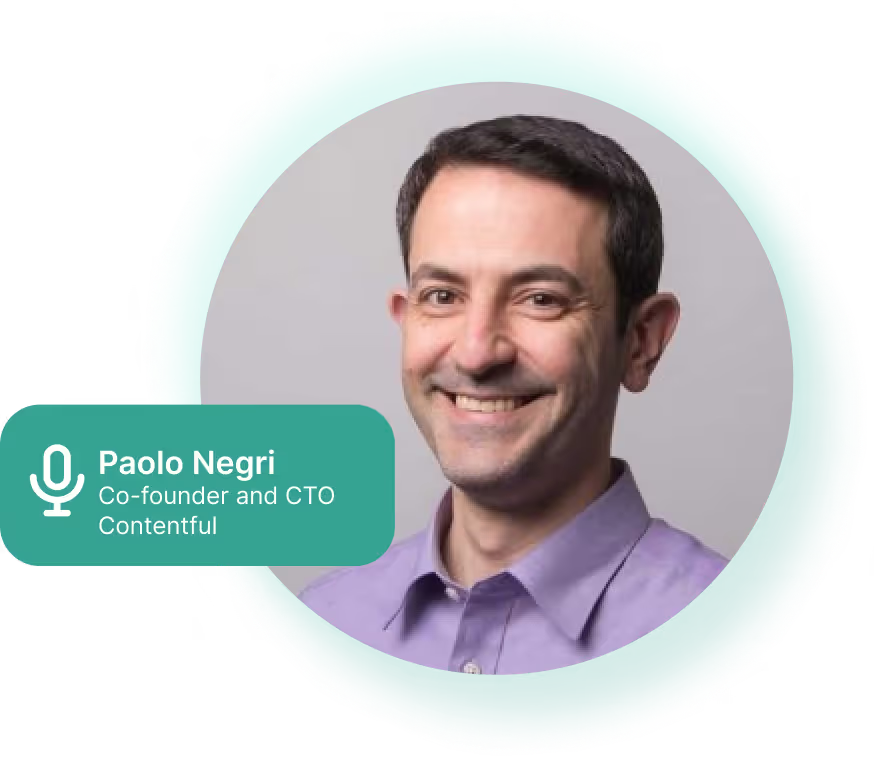
Internal Knowledge Management: Experimentation While Scaling with Paolo Negri, Co-founder at Contentful
Paolo walks us through his early career at startups across Europe, how he built a company solving a problem he faced at those very startups, why he encourages a culture based on experimentation at Contentful, and much more.

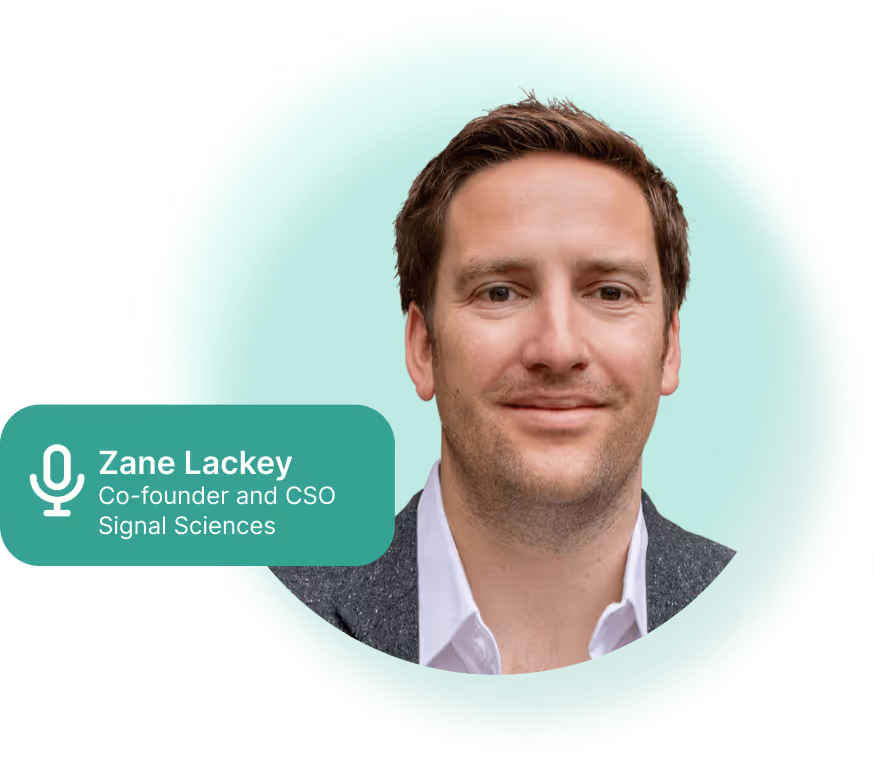
Securing Digital Transformation: Practical Lessons from Signal Sciences with Zane Lackey, Co-founder at Signal Sciences
Zane is a Co-founder and Chief Security Officer at Signal Sciences, a web-application security company acquired by Fastly. Zane shares what his career has taught him about security, founding teams, and what the future holds for digital transformations.

Startup to Enterprise Ops: Lessons for Serial Entrepreneurs with Greg Tacchetti, CIO at State Auto Insurance
Atolio's co-founder Mark Matta interviews Greg Tacchetti, CIO at State Auto Insurance. Greg shares his story, what he learned from his previous experience as a co-founder, which tech he's most excited about these days, and more.

SaaS Sprawl and Transparency: Scaling Internal Employee Directories with Alex Solomon, CTO and Co-founder at PagerDuty
Alex Solomon (CTO & Co-founder at PagerDuty) joins us to talk about the early days at PD and some critical decisions about transparency, documentation, employee experience, and more.


Engineering Transparency: Building a Culture of Urgency (Without Panic) with Steve Zerby, CIO at Owens Corning
Fortune 500 CIO Steve Zerby talks with us about the culture of urgency that he is helping foster at Owens Corning and how it relates to ego, transparency, service, and more.



Purposeful Innovation: Avoiding Single-Vendor Lock-in Risk with Andrew Campbell, CIO at Terex Corporation
Andrew talks with us about a number of topics, including the concept of purposeful innovation at Terex, the drawbacks to single-vendor environments, his reasons for being a servant leader, and more.
CIO Leadership Advice: Lessons from Sales and Go-to-Market with Julie Cullivan, Former Forescout CIO
Julie (Board Director at Axon, HeartFlow, and AaDya) joins us to share how she handled leading both technology & people at Forescout, why she took the leap to become a first-time CIO at FireEye, what she learned from her go-to-market roles at McAfee & Autodesk, and more.
CIO to CPTO Transition: Shaping Product Culture and Curiosity with Ramin Beheshti, CPTO at Dow Jones
Ramin is the Chief Product & Technology Officer at Dow Jones, publisher of The Wall Street Journal, Barrons, Marketwatch, and more. He talks leadership lessons, the value of curiosity, his approach to working with startups, and more.
CIO to VC: Evaluating Startup Tech and Early-Stage Bets with Yousuf Khan, Former 5x CIO
Our first guest is Yousuf Khan, who discusses what he learned on his journey from accidental CIO at companies like Automation Anywhere, Moveworks, and Pure Storage to unconventional VC at Ridge Ventures.