Engineering Transparency: Building a Culture of Urgency (Without Panic) with Steve Zerby, CIO at Owens Corning
Fortune 500 CIO Steve Zerby talks with us about the culture of urgency that he is helping foster at Owens Corning and how it relates to ego, transparency, service, and more.

Steve Zerby
Owens Corning CIO
Engineering Transparency: Building a Culture of Urgency (Without Panic) with Steve Zerby, CIO at Owens Corning
Fortune 500 CIO Steve Zerby talks with us about the culture of urgency that he is helping foster at Owens Corning and how it relates to ego, transparency, service, and more.
1:07 A common mistake in technology leadership
3:31 What is OC’s “culture of urgency?”
8:40 Urgency vs. Panic
10:20 Building a low-ego / no-ego organization
19:46 Having a “flattened” hierarchy: challenges and benefits
23:12 The necessity for skill
“Checking the ego at the door isn’t something we do every day. It’s just who we are.”
Steve Zerby
Owens Corning CIO
Steve Zerby on Building a Culture of Urgency, Leading Without Ego, and Why Being a Lifeguard Is Part of the Job
Steve Zerby, CIO, Owens Corning | Interviewed by Luke Alie of Atolio
Steve Zerby is the CIO at Owens Corning, a Fortune 500 manufacturer of insulation, roofing, and fiberglass composite products with 19,000 employees globally. His IT department is about 200 people, and he's built it around two defining concepts: a culture of urgency and a relentless commitment to low-ego leadership. He explains why urgency is not panic, how flat hierarchies require more explanation not less, and why the brochure you give recruits should match what they actually experience.
Why Getting the Best Out of People Dwarfs Any Technology Project
Luke Alie (LA): Where does your interest in leadership come from?
Steve Zerby (SZ): There's a bit of an irony in technology leadership. If you ask technology leaders what their greatest asset is, they'll say their people. And then thirty-five seconds later in the same meeting they're talking about technology and process, and you never hear them mention people again. Over time, working through hundreds of projects and meetings, it became clear to me that one of the greatest ways to bring lasting benefit to a company is to become a leader who gets the very best out of their team all the time. If you have hundreds of employees and you can get five percent more out of them, that dwarfs almost any technology project, any process reinvention you could ever bring to bear. I became fascinated with how to achieve that in an elegant, behavior-driven way, not through force.
Culture of Urgency: Not Panic, But Purpose
LA: Tell me about the culture of urgency you've built at Owens Corning.
SZ: Developing a culture of urgency isn't really about getting work done faster. It's about becoming genuinely strategic and valuable to your company. There's a kind of CIO complaint list: people want us to be strategic but they cut our budget, they want big things but don't invite us to the meetings. My thought has always been that there are two ways to solve the problem of making the function strategic, and one of them is the culture of urgency.
What it means in practice is this: when somebody brings you a challenge, a problem, or an opportunity, they can never be more urgent about it than you are. In that moment, what they're bringing you has to feel like the most important thing in the world, and you have to behave in a way that demonstrates that. Think about your own life. When are you most disappointed by a service experience? It's when it matters more to you than to the person providing the service. When you feel like you're having a crisis and they're just going through the motions. Urgency corrects that.
The Lifeguard Principle: Crossing the Lines of Your Formal Responsibility
LA: How does that urgency translate to situations outside someone's formal role?
SZ: I tell our team: if you're in a large business meeting and something goes wrong with technology, everyone looks at you. Not okay to say: I don't work on supply chain systems, that's not my department. Think of it like a lifeguard. If you walk past a swimming pool and see someone drowning, you don't keep walking just because you're not on duty. You help. That's the kind of urgency I want from this function. We will encounter problems outside our technical strike zone. Make yourself useful, cross those lines, be that lifeguard in the moment. People will see value in you, and that value translates into being invited into the larger, more strategic conversations in the company.
Urgency vs. Panic: The Difference Is Thoughtfulness
LA: A lot of people hear urgency and think panic.
SZ: They are very different. Urgency is purposeful and thoughtful. It is a response to an opportunity you see in the course of your day, and that opportunity can be tactical or strategic. Panic is an organization not knowing what to do. The people I've worked with and managed who give me a true sense of urgency are also some of the most well-considered people I know. They are never out of control. You find yourself marveling at how quickly they can help solution something without ever being daunted by the size or complexity of the challenge.
No Ego, Low Ego: Building a Team That Competes Outside the Company
LA: What role does ego play in who can and can't be part of your team?
SZ) We prefer a no-ego, low-ego approach. If you can't feel genuinely good about a teammate carrying the flag across the finish line just because it's not you, you probably can't be on our team. You have to be able to derive as much joy from people around you succeeding as from your own success. That frees you up to be impactful in a manufacturing company where the supply chain powered by technology is everything, even if IT is not the headline story in the company magazine. That's fine with us. All that matters is that the supply chain runs as well as it possibly can.
I have a large company of 19,000 employees and an IT organization of 202 people, which is not large for an enterprise our size. When people ask whether we can really attract people who fit that low-ego profile, I remind them: if our attrition rate is three or four percent and we have 202 people, I only need to find six of those people on the planet each year. And the brochure we give them matches the job exactly. People that fit stay. People that don't fit self-select out. Being outwardly honest about who you are and what good looks like here makes recruiting and retention much cleaner.
Flat Hierarchies and the Obligation to Explain the Why
LA: You've spoken about flatter hierarchies enabling faster decisions. Are there drawbacks?
SZ: Yes. When you bring different levels together, the transparency gets very good and the interaction is frequent. But that also means a VP and a more junior person may disagree in the same meeting. You want that kind of inclusive team environment. What you don't want is for people to follow the VP's direction simply because of rank. As you get higher in the organization, it becomes incumbent on you to explain the why: why you thought this was the right direction, what reasoning drove it. If you don't, people start to feel that the hierarchy is flat until it's not. And if the why is credible, it reinforces that the decision was right for the right reasons, not just because someone had more stripes on their shoulder. That patience in explaining decisions is genuinely important.
LA: Steve, thank you so much for coming on.
SZ: All right. Take care.
Latest Episodes


Green Computing and Data Unlocking: Mentorship for Tech Leaders with Andrea Gallego, Global CTO at BCG GAMMA
Andrea Gallego (Global CTO at BCG GAMMA) has taken her career from large financial institutions, to rapidly growing NGOs, and ultimately to this intersection of consulting and tech. Listen in to hear her thoughts on the value of mentorships between women, how she became interested in startup culture, possible new ways to leverage information at consulting groups, and more.
Internal Knowledge Management: Experimentation While Scaling with Paolo Negri, Co-founder at Contentful
Paolo walks us through his early career at startups across Europe, how he built a company solving a problem he faced at those very startups, why he encourages a culture based on experimentation at Contentful, and much more.

Securing Digital Transformation: Practical Lessons from Signal Sciences with Zane Lackey, Co-founder at Signal Sciences
Zane is a Co-founder and Chief Security Officer at Signal Sciences, a web-application security company acquired by Fastly. Zane shares what his career has taught him about security, founding teams, and what the future holds for digital transformations.
Innovation Culture: Enterprise vs. Startup Technology Scaling with Shivani Govil, CPO at CCC Intelligent Solutions
Innovation has been a central focus in Shivani Govil's career, including during her time at Silicon Valley Startups, SAP, and in her current role as Chief Product Officer at CCC Intelligent Solutions, a modern insurance solutions company. We dove into how she thinks innovation works at different scales, business units, industries, and more.
Startup to Enterprise Ops: Lessons for Serial Entrepreneurs with Greg Tacchetti, CIO at State Auto Insurance
Atolio's co-founder Mark Matta interviews Greg Tacchetti, CIO at State Auto Insurance. Greg shares his story, what he learned from his previous experience as a co-founder, which tech he's most excited about these days, and more.

SaaS Sprawl and Transparency: Scaling Internal Employee Directories with Alex Solomon, CTO and Co-founder at PagerDuty
Alex Solomon (CTO & Co-founder at PagerDuty) joins us to talk about the early days at PD and some critical decisions about transparency, documentation, employee experience, and more.



Purposeful Innovation: Avoiding Single-Vendor Lock-in Risk with Andrew Campbell, CIO at Terex Corporation
Andrew talks with us about a number of topics, including the concept of purposeful innovation at Terex, the drawbacks to single-vendor environments, his reasons for being a servant leader, and more.
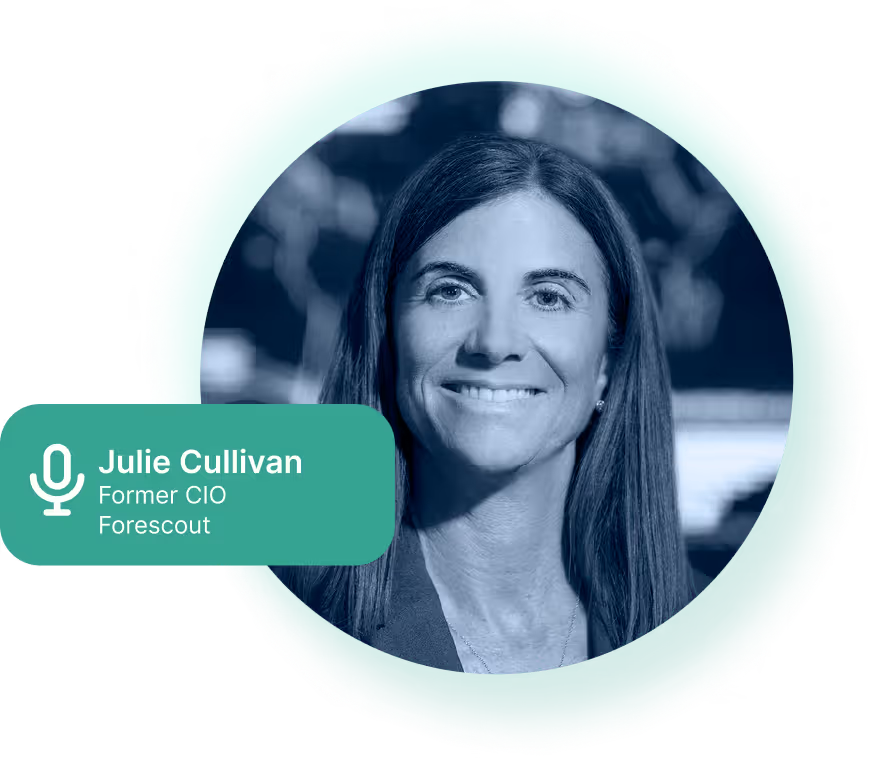
CIO Leadership Advice: Lessons from Sales and Go-to-Market with Julie Cullivan, Former Forescout CIO
Julie (Board Director at Axon, HeartFlow, and AaDya) joins us to share how she handled leading both technology & people at Forescout, why she took the leap to become a first-time CIO at FireEye, what she learned from her go-to-market roles at McAfee & Autodesk, and more.
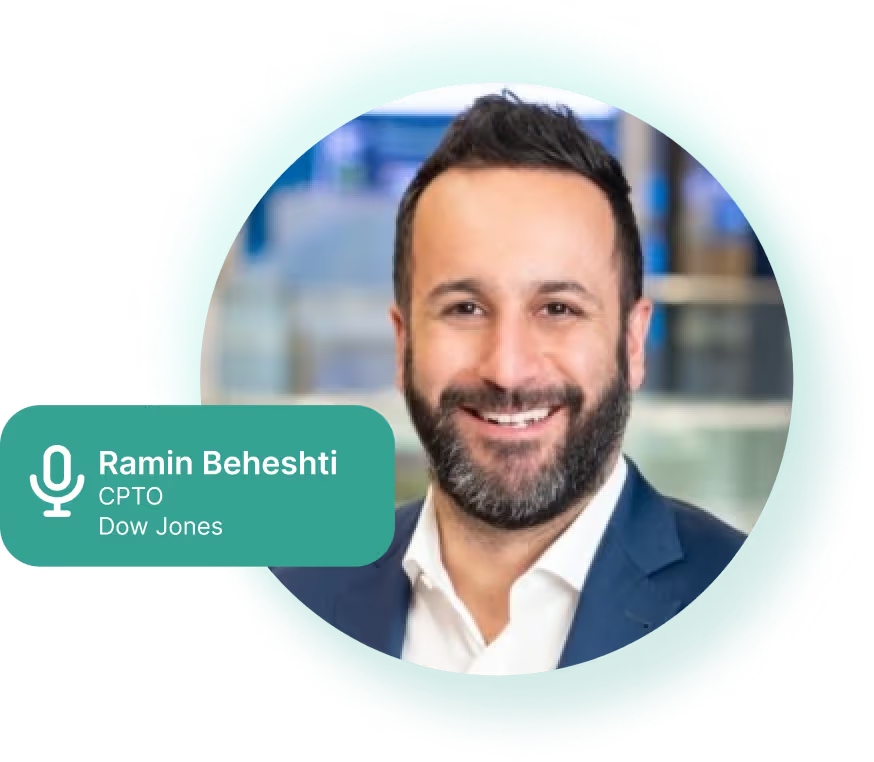
CIO to CPTO Transition: Shaping Product Culture and Curiosity with Ramin Beheshti, CPTO at Dow Jones
Ramin is the Chief Product & Technology Officer at Dow Jones, publisher of The Wall Street Journal, Barrons, Marketwatch, and more. He talks leadership lessons, the value of curiosity, his approach to working with startups, and more.
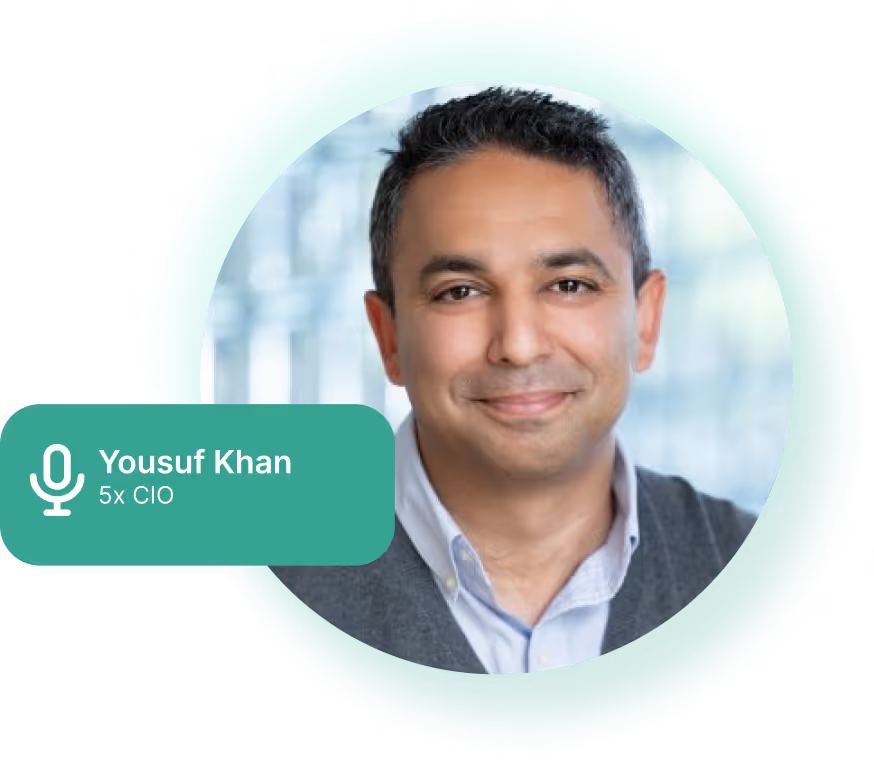
CIO to VC: Evaluating Startup Tech and Early-Stage Bets with Yousuf Khan, Former 5x CIO
Our first guest is Yousuf Khan, who discusses what he learned on his journey from accidental CIO at companies like Automation Anywhere, Moveworks, and Pure Storage to unconventional VC at Ridge Ventures.