Internal Customer Experience: When to Consolidate Tools with Karl Mosgofian, CIO at Gainsight
Gainsight is building innovative customer-centric technology, so we sat down with their CIO, Karl Mosgofian, to hear about how he understands and supports the internal customer.

Karl Mosgofian
Gainsight CIO
Internal Customer Experience: When to Consolidate Tools with Karl Mosgofian, CIO at Gainsight
Gainsight is building innovative customer-centric technology, so we sat down with their CIO, Karl Mosgofian, to hear about how he understands and supports the internal customer.
0:55 CX & EX
4:37 Getting the most out of a survey
10:42 When to consolidate around a tool
15:13 Advice for improving employee experience
“For goodness sakes, do what you can to make people effective and make their tools better. ”
Karl Mosgofian
Gainsight CIO
Karl Mosgofian on Customer Success Thinking Inside IT, Employee Experience Surveys, and the Collaboration Tool Dilemma
Karl Mosgofian, CIO, Gainsight | Interviewed by Luke Alie of Atolio
Karl Mosgofian is the CIO at Gainsight, whose software helps companies improve customer success, reduce churn, and grow net revenue retention. In this conversation he talks about how Gainsight's customer-first philosophy naturally shapes how IT thinks about internal employees as customers, how longitudinal employee surveys can surface meaningful signals without generating noise, and the difficult truth about collaboration tools: sometimes the people using different tools are actually happier.
Customer Success Thinking Applied Internally: How Gainsight's Culture Shapes IT
Luke Alie (LA): Gainsight's whole focus is customer success. Does that mindset carry over into how IT operates internally?
Karl Mosgofian (KM): Gainsight is all about increasing net revenue retention by improving customer success, product experience, and customer experience tools. The core idea is that you need to understand what outcomes your customers are trying to achieve and make them successful. That same mindset does in fact apply internally. I hadn't consciously thought about it framed that way until you asked, but it's a great way to think about it. We also have a very strong human-first culture here. Caring about the employee experience is not lip service. It's something we pay real attention to.
The parallel to customer success tools is real. In customer success you maintain stakeholder alignment, you track relationship health, you make sure you're having check-ins at the right level. IT has understood for a long time that if you aren't staying connected to the right people, you'll get in trouble. You need people doing the real work to tell you whether your tools are working for them. And you need to be aligned with executives at the strategic level too.
Longitudinal Employee Surveys: The Value of Asking the Same Questions Over Time
LA: How do you measure employee experience in IT?
KM): One of the things we've been doing for a while is surveying employees consistently, and asking roughly the same questions over a period of years. You get a lot of value from doing it once. You get even more value from tracking trends over time. Are we moving up or down on this? Where are we going? The single most valuable question is probably something like: do you have the tools you need to do your job? Because at the end of the day that's what it's about. I almost don't want to go more granular than that at the survey level.
If people say overall they are happy, that's a signal to not overreact to individual outliers. If people say overall they're frustrated, that's my cue to go deeper: hold focus groups, have conversations, investigate. The survey gives me a compass. It's not the full picture. And it's particularly important to make sure you're hearing from everyone, not just the US office, not just people in the building. If you're a global company, you need those voices from around the world.
The Collaboration Tool Dilemma: When Standardization Hurts the People It's Meant to Help
LA: If everyone is using the same tools, survey data becomes more comparable. But is standardization always right?
KM): This is where it gets complicated. My instinct as an IT person is that I want as much commonality as possible, fewer vendors, more integration. But if the reason some people are happy with their tools is precisely because their team gets to use something that works for them, and I come in and rip that away to standardize, I will have shot myself in the foot while thinking I was doing the right thing.
I also think a siloed collaboration tool is an oxymoron. If someone says their team uses a different project management tool and it's fine because they only use it internally, I'd say: that's not how it will stay. You collaborate with other teams. Pretty soon you've got four or five different tools because each team uses a different one depending on who they're working with. There's a real argument for standardizing on collaboration tools. And yet different tools genuinely do work better for different groups. It's a constant tension I don't pretend to have solved.
The middle ground I've found most useful is: commit to broad platforms that everyone uses, like Slack, and connect as much as possible into those. That may be the best you can do. Someone can be happy with their own tool and still participate in the broader system. And in a world where even large companies can't truly stop individuals from spinning up a Trello account, the question isn't whether you can enforce standardization but how you find a happy middle ground.
Advice for CIOs: Treat Employee Experience as an Ongoing Discipline, Not a Project
LA: Any other advice for CIOs thinking about employee experience?
KM): Think of it as an agile discipline, not a project with an end. There is no one perfect tool. There is no perfect vendor analysis that solves it forever. You try something, get feedback, iterate. And someone needs to own that process continuously. Think about the carpenter with the bad hammer: that person uses that hammer all day. If an information worker tells you their laptop is frustrating or their video software is broken, you are wise to take that seriously. Especially now, when many companies are reducing office footprint: take some of those savings and invest them in the tools people actually use all day.
LA: Karl, thank you so much for talking with me today.
KM): This was a great conversation. You actually made me think about some things differently. I appreciate that.
Latest Episodes

Green Computing and Data Unlocking: Mentorship for Tech Leaders with Andrea Gallego, Global CTO at BCG GAMMA
Andrea Gallego (Global CTO at BCG GAMMA) has taken her career from large financial institutions, to rapidly growing NGOs, and ultimately to this intersection of consulting and tech. Listen in to hear her thoughts on the value of mentorships between women, how she became interested in startup culture, possible new ways to leverage information at consulting groups, and more.
Internal Knowledge Management: Experimentation While Scaling with Paolo Negri, Co-founder at Contentful
Paolo walks us through his early career at startups across Europe, how he built a company solving a problem he faced at those very startups, why he encourages a culture based on experimentation at Contentful, and much more.

Securing Digital Transformation: Practical Lessons from Signal Sciences with Zane Lackey, Co-founder at Signal Sciences
Zane is a Co-founder and Chief Security Officer at Signal Sciences, a web-application security company acquired by Fastly. Zane shares what his career has taught him about security, founding teams, and what the future holds for digital transformations.
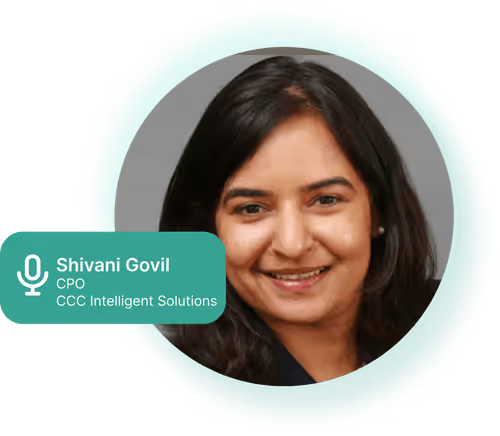
Innovation Culture: Enterprise vs. Startup Technology Scaling with Shivani Govil, CPO at CCC Intelligent Solutions
Innovation has been a central focus in Shivani Govil's career, including during her time at Silicon Valley Startups, SAP, and in her current role as Chief Product Officer at CCC Intelligent Solutions, a modern insurance solutions company. We dove into how she thinks innovation works at different scales, business units, industries, and more.
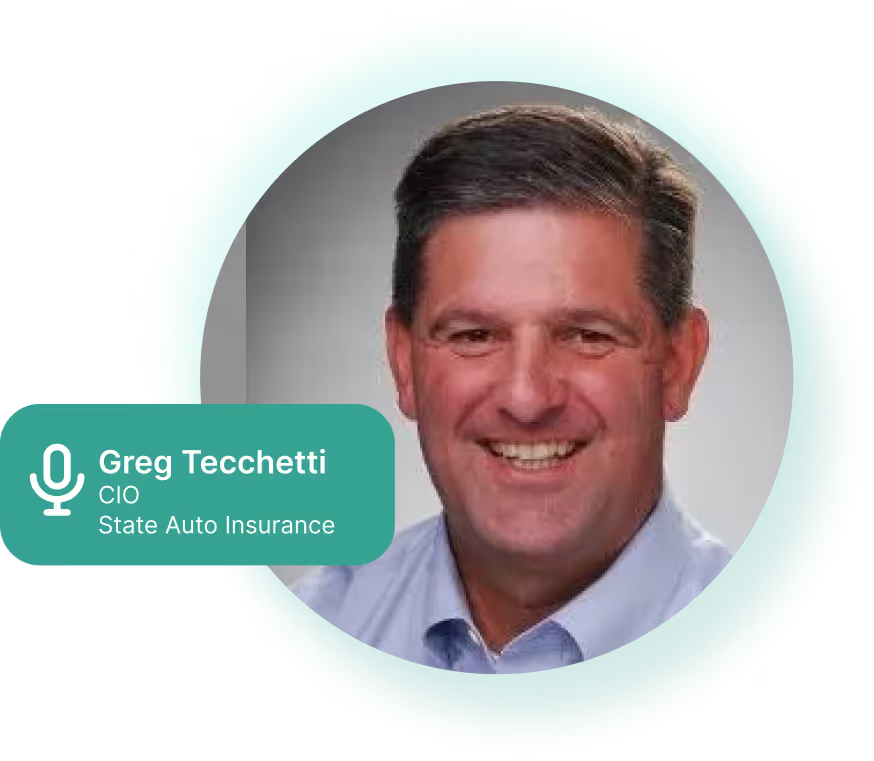
Startup to Enterprise Ops: Lessons for Serial Entrepreneurs with Greg Tacchetti, CIO at State Auto Insurance
Atolio's co-founder Mark Matta interviews Greg Tacchetti, CIO at State Auto Insurance. Greg shares his story, what he learned from his previous experience as a co-founder, which tech he's most excited about these days, and more.

SaaS Sprawl and Transparency: Scaling Internal Employee Directories with Alex Solomon, CTO and Co-founder at PagerDuty
Alex Solomon (CTO & Co-founder at PagerDuty) joins us to talk about the early days at PD and some critical decisions about transparency, documentation, employee experience, and more.
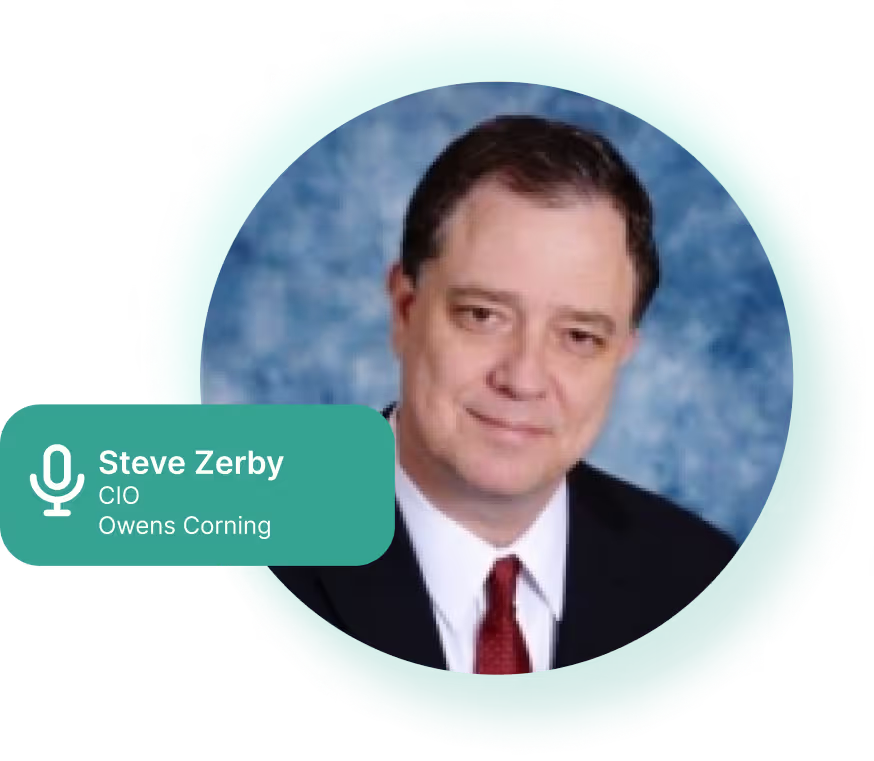
Engineering Transparency: Building a Culture of Urgency (Without Panic) with Steve Zerby, CIO at Owens Corning
Fortune 500 CIO Steve Zerby talks with us about the culture of urgency that he is helping foster at Owens Corning and how it relates to ego, transparency, service, and more.

Purposeful Innovation: Avoiding Single-Vendor Lock-in Risk with Andrew Campbell, CIO at Terex Corporation
Andrew talks with us about a number of topics, including the concept of purposeful innovation at Terex, the drawbacks to single-vendor environments, his reasons for being a servant leader, and more.
CIO Leadership Advice: Lessons from Sales and Go-to-Market with Julie Cullivan, Former Forescout CIO
Julie (Board Director at Axon, HeartFlow, and AaDya) joins us to share how she handled leading both technology & people at Forescout, why she took the leap to become a first-time CIO at FireEye, what she learned from her go-to-market roles at McAfee & Autodesk, and more.
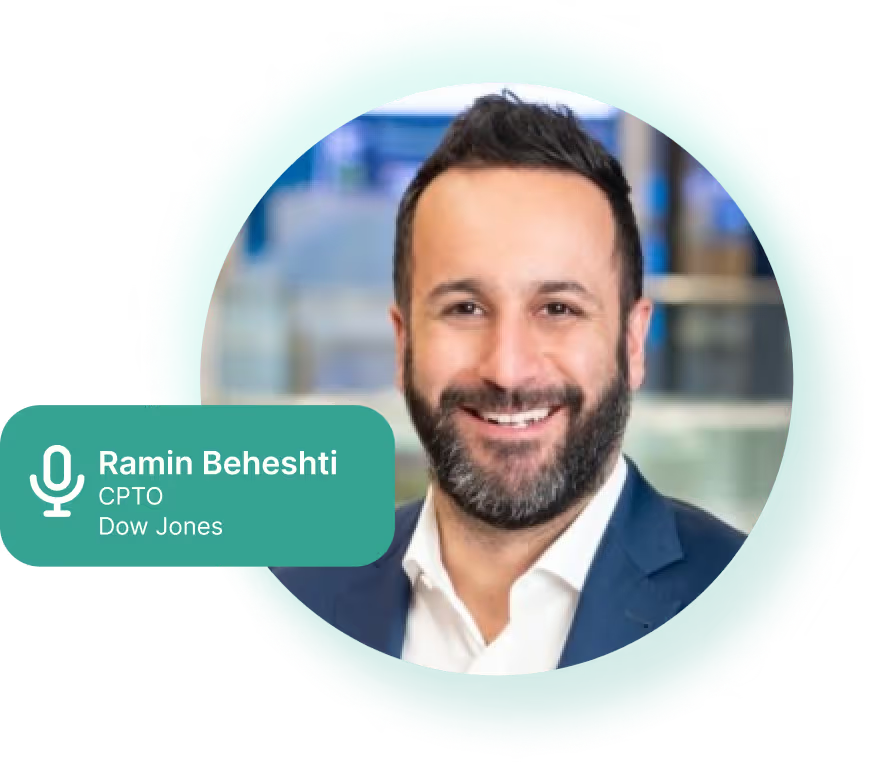
CIO to CPTO Transition: Shaping Product Culture and Curiosity with Ramin Beheshti, CPTO at Dow Jones
Ramin is the Chief Product & Technology Officer at Dow Jones, publisher of The Wall Street Journal, Barrons, Marketwatch, and more. He talks leadership lessons, the value of curiosity, his approach to working with startups, and more.
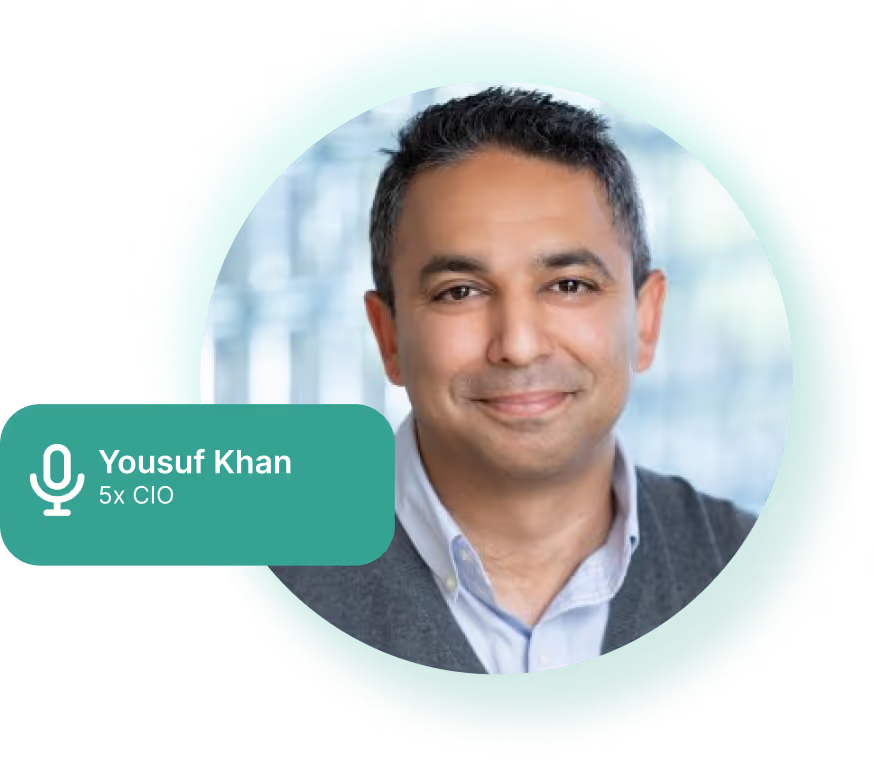
CIO to VC: Evaluating Startup Tech and Early-Stage Bets with Yousuf Khan, Former 5x CIO
Our first guest is Yousuf Khan, who discusses what he learned on his journey from accidental CIO at companies like Automation Anywhere, Moveworks, and Pure Storage to unconventional VC at Ridge Ventures.