CIO to CPTO Transition: Shaping Product Culture and Curiosity with Ramin Beheshti, CPTO at Dow Jones
Ramin is the Chief Product & Technology Officer at Dow Jones, publisher of The Wall Street Journal, Barrons, Marketwatch, and more. He talks leadership lessons, the value of curiosity, his approach to working with startups, and more.

Ramin Beheshti
Dow Jones CPTO
CIO to CPTO Transition: Shaping Product Culture and Curiosity with Ramin Beheshti, CPTO at Dow Jones
Ramin is the Chief Product & Technology Officer at Dow Jones, publisher of The Wall Street Journal, Barrons, Marketwatch, and more. He talks leadership lessons, the value of curiosity, his approach to working with startups, and more.
1:32 From CIO to CPTO
2:35 Lessons from Paul Cheesbrough
4:38 How can leaders shape their company’s culture?
7:30 Connecting with audiences
11:19 The value of curiosity
12:30 Ramin’s work with Dropbox, Slack, and New Relic
15:00 Your customer’s wants vs. needs
“A startup’s success comes down to listening to the customer. ”
Ramin Beheshti
Dow Jones CPTO
Ramin Beheshti on Becoming CPTO at Dow Jones, Unlearning What Got You Here, and Why Culture Is Observed, Not Declared
Ramin Beheshti, CPTO, Dow Jones (WSJ, Barron's, MarketWatch) | Interviewed by Luke Alie of Atolio
Ramin Beheshti is the Chief Product and Technology Officer at Dow Jones, publisher of the Wall Street Journal, Barron's, and MarketWatch. He came to the role through a background in product and engineering, took a deliberate detour as CIO to understand how to run the operational side, and then combined both functions. In this conversation he talks about connecting the right content format to the right audience, the parallel between how news organizations think about readers and how technology leaders should think about employees, what intellectual curiosity signals about leadership potential, and why culture is something observed rather than declared.
From CIO to CPTO: Why Ramin Went Backward to Move Forward
Luke Alie (LA): You went from product and engineering to CIO and then to CPTO. That's an unusual path. What drove it?
Ramin Beheshti (RB): I came from a product and engineering background and my boss at the time said: why would you go back and run operations and infrastructure after being in digital? And I said: I know product and digital. What I don't know is how to run the enterprise. And I think there's things I can take from that and apply to internal customers.
The CIO experience was genuinely humbling. In any organization, all of the parts need focus and attention. There's no point having an amazing product and UX function and throwing it over the fence to engineering, and then engineering throwing it over the fence to a substandard infrastructure team. Being able to appreciate all sides of what it takes to deliver great experiences, internally and externally, was the key lesson. And once I had that holistic view, combining product and technology in one role made complete sense.
Connecting the Right Content Format to the Right Audience
LA: You're in a unique position facilitating the flow of information at the Wall Street Journal. How do you think about matching content format to audience?
RB: The consumption of news is becoming increasingly fragmented. And part of that is because news organizations haven't evolved how they tell stories from the way they always have. They're still overly reliant on text-based delivery. That works for some audiences. It doesn't work for all.
One of the things we tried to do at Dow Jones was help connect the right format to the right audience at the right moment. I'll give you an example. I have five minutes, you have an hour. You are walking somewhere. I'm at my desk. I'm visual, you're not. Those contexts mean we should be receiving the same news in completely different formats. When you're trying to capture and keep people's attention, understanding those varying need states is critical.
Employees as Customers: The Leadership Lesson That Crosses Both Roles
LA: Are there parallels between how you communicate with readers and how you communicate inside the organization?
RB: One of my learnings as a CIO is that people tend to delineate between employees and customers when they are actually the same people. Your employees are also consumers of other products and experiences. The same principles that tell you how to connect with a news reader apply to how you communicate with your team.
Too often leaders say: I communicated to the team through this mechanism but they didn't understand it. And the implication is that's their problem. But actually it's your job to communicate effectively across different people who hear and process things in different ways. Time of day, format, context all matter. The way you should look at your employees is the same way you look at external-facing product customers. The delineation between those groups is not actually helpful.
Two Traits Ramin Looks for in Leaders: Curiosity and Unlearning
LA: What traits do you think are underrated in identifying strong leaders?
RB: Intellectual curiosity. Specifically: do you ask why? A lot. Curiosity typically comes together with humility, because if you're genuinely curious you tend to acknowledge that you don't have all the answers. Those two things are linked.
The second thing I always tell people as they move up in an organization is that you have to unlearn the behaviors that got you to your current position. What got you here is not what's going to keep you here or take you further. I learned that directly. I was excellent at getting hold of a situation and sorting things out. People would bring me in when things weren't going well. That's how I made my name. But as a leader, that behavior is deeply disempowering to your team. I had to unlearn the instinct to fix problems for everyone and learn instead to create space for the team to figure it out, to protect them so they have the time to work it through. Is it a journey? Yes. Can you wave a magic wand? No. But being aware of it and continuing to improve is what matters.
The Peer Community of CIOs and CTOs: Why It's Invaluable
LA: How important has the CIO and CTO peer community been to your development?
RB: Invaluable. Technology is evolving so quickly that no single person can keep up. Six or seven years ago we were still debating whether to move to the cloud. The cloud has changed beyond recognition since then. The community tells you who is on the leading edge, what mistakes others have made, and where the later adopters are in their journey. You need that perspective to calibrate where you are and where you should be. I think it's one of the fastest-changing fields there is, and your peer group is how you keep pace.
Data Academy and the Democratization of Technology
LA: You created something called a Data Academy internally at Dow Jones. Can you tell me about that?
RB: We created the Data Academy to improve data literacy across the entire organization, not just within the technology team. It comes from a belief I hold strongly: technology should not only be in the hands of technologists. That is a very old-school approach. The more you federate technology and put it closer to the customer and closer to where decisions are being made, the better the solutions you can build. The modern role of a technology team is partly building core customer experiences, and partly providing platforms that others can leverage and build on. That combination unlocks the creativity and problem-solving of the whole organization, not just the technical function.
Culture Is Observed, Not Declared
LA: What's your view on organizational culture, particularly in technology?
RB: Culture is observed, not declared. Just because you put a poster on the wall or write values in a slide deck does not make that the culture. The culture is what people actually experience: how decisions are made, how mistakes are handled, how empowered or disempowered people feel. Being consistent in what you say and how you behave is how culture actually forms.
I'll give you a concrete example. I wanted everyone in the organization to feel empowered. I said it constantly. But some teams were completely empowered and others wouldn't make a decision without approval. The gap wasn't the message. It was the behavior. When a team acted with empowerment and made a mistake, if I then seemed to berate them, no one else would stick their neck out, no matter how many times I had said the word empowered. Culture lives in those moments. In what actually happens when things go wrong.
LA: Ramin, thank you so much for coming on the show.
RB: That was a lot of fun. I really enjoyed it.
Latest Episodes


Green Computing and Data Unlocking: Mentorship for Tech Leaders with Andrea Gallego, Global CTO at BCG GAMMA
Andrea Gallego (Global CTO at BCG GAMMA) has taken her career from large financial institutions, to rapidly growing NGOs, and ultimately to this intersection of consulting and tech. Listen in to hear her thoughts on the value of mentorships between women, how she became interested in startup culture, possible new ways to leverage information at consulting groups, and more.
Internal Knowledge Management: Experimentation While Scaling with Paolo Negri, Co-founder at Contentful
Paolo walks us through his early career at startups across Europe, how he built a company solving a problem he faced at those very startups, why he encourages a culture based on experimentation at Contentful, and much more.

Securing Digital Transformation: Practical Lessons from Signal Sciences with Zane Lackey, Co-founder at Signal Sciences
Zane is a Co-founder and Chief Security Officer at Signal Sciences, a web-application security company acquired by Fastly. Zane shares what his career has taught him about security, founding teams, and what the future holds for digital transformations.
Innovation Culture: Enterprise vs. Startup Technology Scaling with Shivani Govil, CPO at CCC Intelligent Solutions
Innovation has been a central focus in Shivani Govil's career, including during her time at Silicon Valley Startups, SAP, and in her current role as Chief Product Officer at CCC Intelligent Solutions, a modern insurance solutions company. We dove into how she thinks innovation works at different scales, business units, industries, and more.

Startup to Enterprise Ops: Lessons for Serial Entrepreneurs with Greg Tacchetti, CIO at State Auto Insurance
Atolio's co-founder Mark Matta interviews Greg Tacchetti, CIO at State Auto Insurance. Greg shares his story, what he learned from his previous experience as a co-founder, which tech he's most excited about these days, and more.

SaaS Sprawl and Transparency: Scaling Internal Employee Directories with Alex Solomon, CTO and Co-founder at PagerDuty
Alex Solomon (CTO & Co-founder at PagerDuty) joins us to talk about the early days at PD and some critical decisions about transparency, documentation, employee experience, and more.

Engineering Transparency: Building a Culture of Urgency (Without Panic) with Steve Zerby, CIO at Owens Corning
Fortune 500 CIO Steve Zerby talks with us about the culture of urgency that he is helping foster at Owens Corning and how it relates to ego, transparency, service, and more.



Purposeful Innovation: Avoiding Single-Vendor Lock-in Risk with Andrew Campbell, CIO at Terex Corporation
Andrew talks with us about a number of topics, including the concept of purposeful innovation at Terex, the drawbacks to single-vendor environments, his reasons for being a servant leader, and more.
CIO Leadership Advice: Lessons from Sales and Go-to-Market with Julie Cullivan, Former Forescout CIO
Julie (Board Director at Axon, HeartFlow, and AaDya) joins us to share how she handled leading both technology & people at Forescout, why she took the leap to become a first-time CIO at FireEye, what she learned from her go-to-market roles at McAfee & Autodesk, and more.
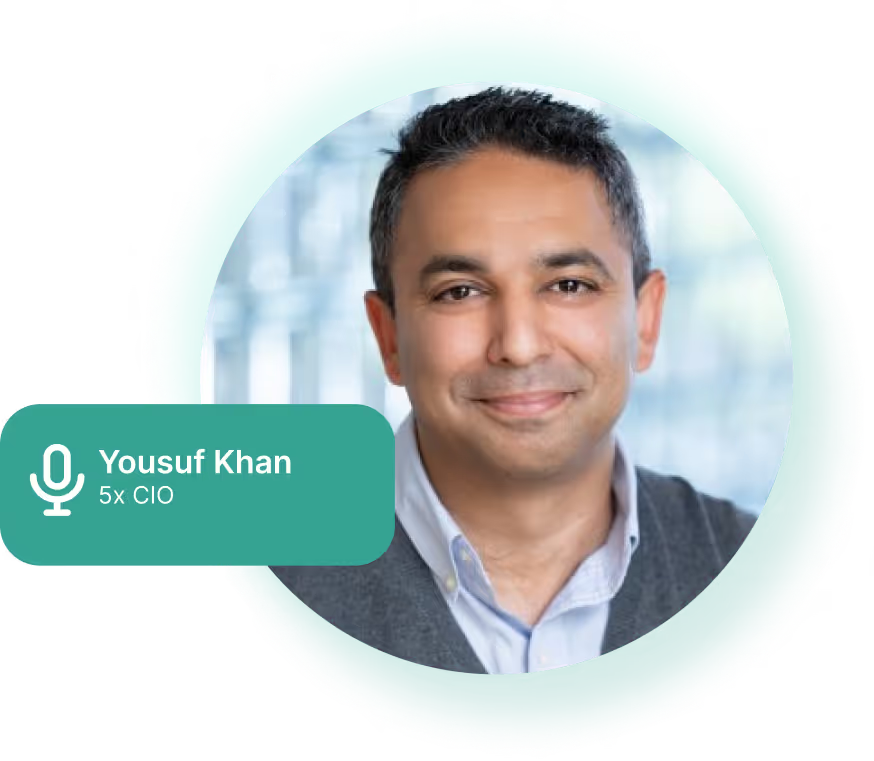
CIO to VC: Evaluating Startup Tech and Early-Stage Bets with Yousuf Khan, Former 5x CIO
Our first guest is Yousuf Khan, who discusses what he learned on his journey from accidental CIO at companies like Automation Anywhere, Moveworks, and Pure Storage to unconventional VC at Ridge Ventures.