AI and LLMs in Engineering: Scaling from Startup to 1,000 Employees with Jon Mort, CTO at The Adaptavist Group
Gareth Watts (Atolio CTO) interviews Jon Mort (CTO at The Adaptavist Group) about his career, the future of tech, and their partnership with Atolio.
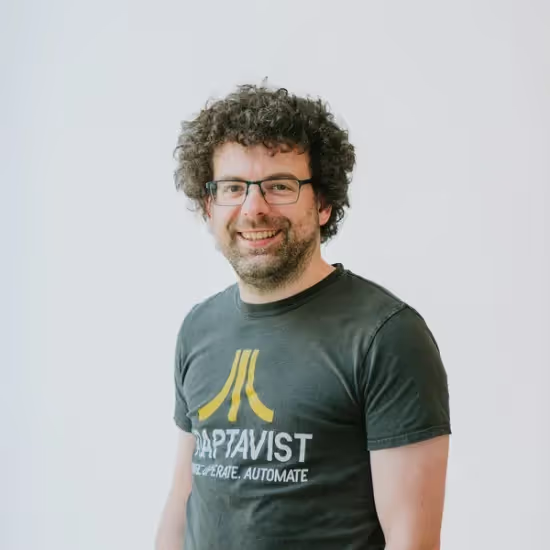
Jon Mort
CTO at The Adaptavist Group
AI and LLMs in Engineering: Scaling from Startup to 1,000 Employees with Jon Mort, CTO at The Adaptavist Group
Gareth Watts (Atolio CTO) interviews Jon Mort (CTO at The Adaptavist Group) about his career, the future of tech, and their partnership with Atolio.
01:00 Curiosity & breaking things
15:45 Is the internet moving towards or away from standardization?
18:35 Tough lessons from a failed startup
22:12 How The Adaptivist Group is building better businesses
28:13 Growing from 12 employees to over 1,000
31:17 Moving from engineering to managing
34:42 The future of AI and LLM’s in engineering
38:15 Why The Adaptavist Group partners with Atolio
41:45 The importance of connecting collaborators
44:48 What’s next for The Adaptavist Group?
“One of the things I always look for in technology is the human connection part. How does that enrich relationships and shared understanding because there is so much power in teams.”
Jon Mort
CTO at The Adaptavist Group
Jon Mort on Growing Adaptivist to a Thousand People, AI as a Coding Partner, and the Power of Connecting Teams Who Did Not Know They Needed Each Other
Jon Mort, CTO, The Adaptavist Group | Interviewed by Gareth Watts of Atolio
Jon Mort is the CTO at The Adaptavist Group, which helps companies get more out of their Atlassian, Monday.com, and GitLab tooling. Gareth Watts, Atolio's own CTO, talks with Jon about his nerdy path through computing, what it has been like helping Adaptavist grow from 12 people to over a thousand, how he thinks about AI's real role in engineering today, and why the most exciting thing about tools like Atolio isn't finding documents but finding the people who have the knowledge you need.
The Nerdy Path In: From Breaking Computers to Building a Career
Gareth Watts (GW): How did you get started in engineering? Was it a childhood passion?
Jon Mort (JM): I was a very mathy kid. I just loved solving problems. My parents got an early Amstrad computer that I broke several times programming on it. I absolutely loved it. Then I went to university to study artificial intelligence because I thought that was the future. It turns out I was wrong in the short term and right in the longer term. I went straight into software engineering roles out of university and spent the next couple of decades there. It's that love of maths and problem solving from early on that got me into this world.
The thing about getting kids into computing today is genuinely different. When I was young, the internet didn't exist. You typed in programs from books, you tried them, you edited them. You were very focused because that was literally all you could do. Now kids are bombarded with options: Minecraft, Scratch, everything else. My eldest is big into mountain biking, and I try to encourage him to think about how the mechanical problems he solves there translate into broader problem-solving skills. The key message is always curiosity and fearlessness. Not being afraid to break things is how you actually learn.
Learning by Going Deep: Linux from Scratch, LLMs, and the Value of Building Upward
GW: Do you think that approach of building from first principles still transfers to things like machine learning today?
JM: Absolutely. I've gone through some of the FastAI material that Jeremy Howard puts together and the resources that Andrej Karpathy puts out, and I think you get a completely different level of understanding from building something up from very basic building blocks. Seeing the gap between a super-simple thing you can build yourself and the superpower of something like GPT-4 gives you a real appreciation for where the magic and the effort actually lives. It also demystifies it. Once you understand what's happening under the hood, you can reason about what these tools are good for and what you should avoid.
AI in Engineering: Superpowers for Developers, Not Replacements
GW: How do you see AI changing the engineering function?
JM: The person who is going to take your job is someone who can use the available tools better, as has always been the case with any new technology. When Google came around, the people who figured out how to use search engines to be more efficient at their jobs did better as a result. LLMs are the same category of shift.
For engineering specifically, what I see is that you're doing a lot more code review. You've now got a coding partner sitting there the whole time generating suggestions. Some of it is brilliant. Some of it is wrong. Some of it is nearly right but has a subtle mistake that you need critical thinking to catch. It's a partnership, a kind of two-way coaching. And I pushed back hard when our finance team suggested it might replace junior engineers. It gives them superpowers. That is a completely different thing.
The critical thinking element is irreducible. Someone still needs to ask: is this the right thing to be building at all? No tool changes that. My advice to teams is to build for the capabilities that are coming, not just what exists today. If you're thinking about what you can do right now or three months ago, you'll always be lagging. Think about the product you can build in six months given the trajectory of improvement. And make sure you're building in a way that lets you swap in better models as they arrive.
Why Adaptavist and Atolio Are Working Together
GW: You connected with us fairly early. What did you see that made you interested?
JM: The first contact I had was through Mark, your co-founder, who had heard me talk about information management on a podcast. He reached out and said: we have this thing, what do you think?
The problem he described is one we see with a lot of customers. You have information everywhere. Knowing where to go to find what you need requires a tremendous amount of institutional knowledge. We had actually tried to build a unified search into Confluence for a customer once: an engineering team searching across their codebase, wiki, issue trackers, and requirements system. They didn't really use it. Not because the idea was wrong, but because it wasn't complete. If it doesn't cover all the sources people need, they don't trust it. That completeness problem is exactly what makes the challenge hard.
What excited me about Atolio was two things. First, the permissions model. You're doing permissions properly across all systems. That is genuinely hard and most solutions skip it. Second, the social graph element. It's not just about finding documents. It's about finding people. In our systems there are teams working with Terraform experts that I had no idea existed elsewhere in the organization. Being able to surface that, to connect teams who are working in similar areas without knowing it: that is enormously valuable. Finding information is great. Finding the people who have the knowledge, especially in an organization of hundreds or thousands, is even better.
What's Next for Adaptavist: LLMs, Experimentation, and Staying Curious
GW: What are you most excited about looking ahead at Adaptavist?
JM: We are doing a lot of work with LLMs and thinking about how to improve workflows and team velocity using them. We have an experimentation framework and we're building toward flexible integrations with multiple foundation models to see what is best for which use case. A couple of products are incubating in this area that I would love to talk about but our teams would shoot me if I did before they're ready.
More broadly, I see it as very much an explore-and-exploit moment. We are firmly in the explore stage. We need to stay curious and learn what actually changes before we nail things down. The landscape is moving so quickly. What works today may work better tomorrow or may be displaced by something completely different. Being flexible around that is absolutely key. And the thing I always look for in technology: how does it enrich human connection? How does it enrich shared understanding and community? Because that's where all the real power is. The organization is its people and how they connect. Everything else is infrastructure.
GW: Thanks so much, Jon. I really appreciate you joining us.
JM: Thanks Gareth. It's been a good conversation. I've enjoyed it.
Latest Episodes

Green Computing and Data Unlocking: Mentorship for Tech Leaders with Andrea Gallego, Global CTO at BCG GAMMA
Andrea Gallego (Global CTO at BCG GAMMA) has taken her career from large financial institutions, to rapidly growing NGOs, and ultimately to this intersection of consulting and tech. Listen in to hear her thoughts on the value of mentorships between women, how she became interested in startup culture, possible new ways to leverage information at consulting groups, and more.
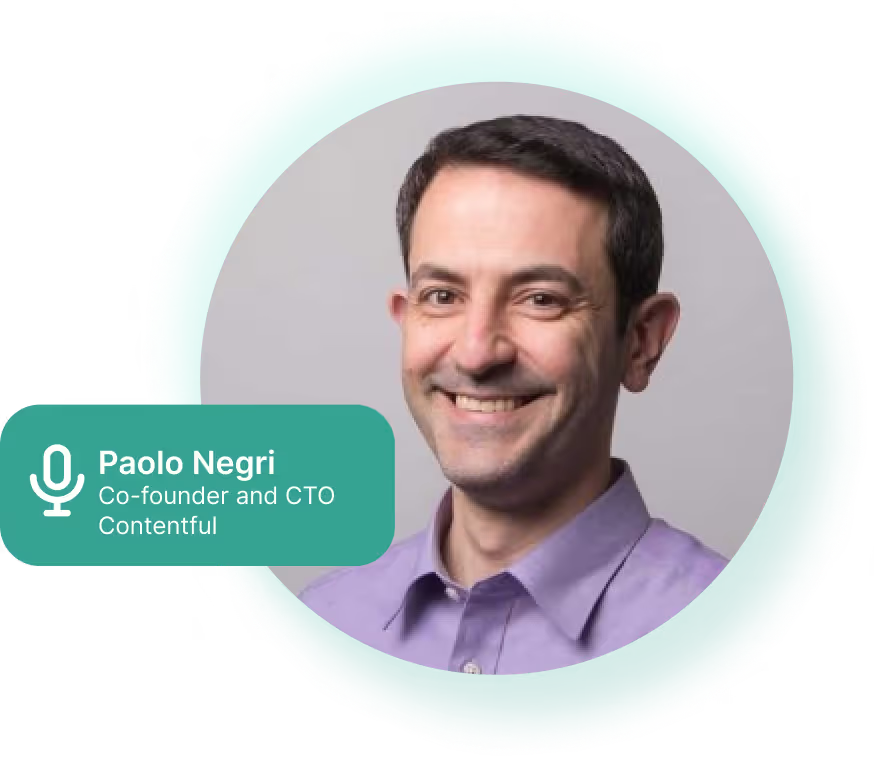
Internal Knowledge Management: Experimentation While Scaling with Paolo Negri, Co-founder at Contentful
Paolo walks us through his early career at startups across Europe, how he built a company solving a problem he faced at those very startups, why he encourages a culture based on experimentation at Contentful, and much more.

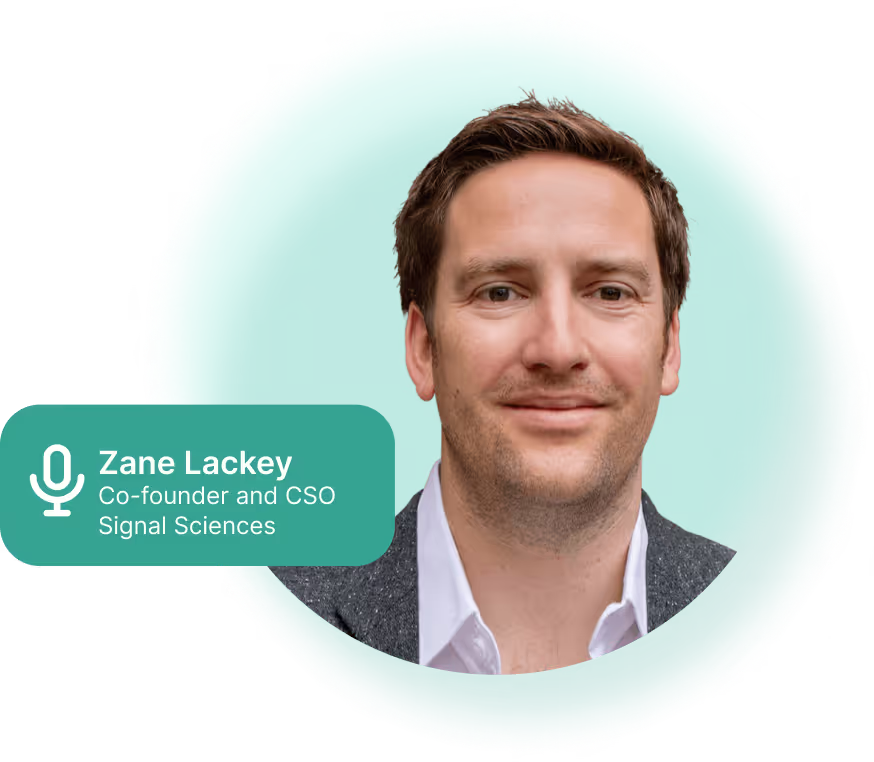
Securing Digital Transformation: Practical Lessons from Signal Sciences with Zane Lackey, Co-founder at Signal Sciences
Zane is a Co-founder and Chief Security Officer at Signal Sciences, a web-application security company acquired by Fastly. Zane shares what his career has taught him about security, founding teams, and what the future holds for digital transformations.
Innovation Culture: Enterprise vs. Startup Technology Scaling with Shivani Govil, CPO at CCC Intelligent Solutions
Innovation has been a central focus in Shivani Govil's career, including during her time at Silicon Valley Startups, SAP, and in her current role as Chief Product Officer at CCC Intelligent Solutions, a modern insurance solutions company. We dove into how she thinks innovation works at different scales, business units, industries, and more.
Startup to Enterprise Ops: Lessons for Serial Entrepreneurs with Greg Tacchetti, CIO at State Auto Insurance
Atolio's co-founder Mark Matta interviews Greg Tacchetti, CIO at State Auto Insurance. Greg shares his story, what he learned from his previous experience as a co-founder, which tech he's most excited about these days, and more.

SaaS Sprawl and Transparency: Scaling Internal Employee Directories with Alex Solomon, CTO and Co-founder at PagerDuty
Alex Solomon (CTO & Co-founder at PagerDuty) joins us to talk about the early days at PD and some critical decisions about transparency, documentation, employee experience, and more.
Engineering Transparency: Building a Culture of Urgency (Without Panic) with Steve Zerby, CIO at Owens Corning
Fortune 500 CIO Steve Zerby talks with us about the culture of urgency that he is helping foster at Owens Corning and how it relates to ego, transparency, service, and more.



Purposeful Innovation: Avoiding Single-Vendor Lock-in Risk with Andrew Campbell, CIO at Terex Corporation
Andrew talks with us about a number of topics, including the concept of purposeful innovation at Terex, the drawbacks to single-vendor environments, his reasons for being a servant leader, and more.
CIO Leadership Advice: Lessons from Sales and Go-to-Market with Julie Cullivan, Former Forescout CIO
Julie (Board Director at Axon, HeartFlow, and AaDya) joins us to share how she handled leading both technology & people at Forescout, why she took the leap to become a first-time CIO at FireEye, what she learned from her go-to-market roles at McAfee & Autodesk, and more.
CIO to CPTO Transition: Shaping Product Culture and Curiosity with Ramin Beheshti, CPTO at Dow Jones
Ramin is the Chief Product & Technology Officer at Dow Jones, publisher of The Wall Street Journal, Barrons, Marketwatch, and more. He talks leadership lessons, the value of curiosity, his approach to working with startups, and more.
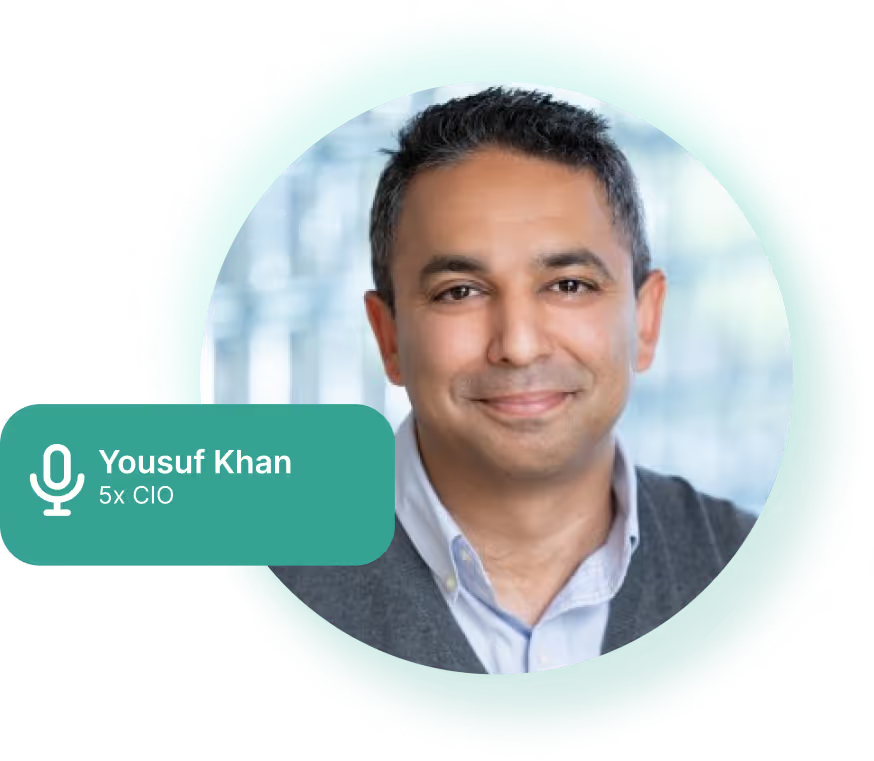
CIO to VC: Evaluating Startup Tech and Early-Stage Bets with Yousuf Khan, Former 5x CIO
Our first guest is Yousuf Khan, who discusses what he learned on his journey from accidental CIO at companies like Automation Anywhere, Moveworks, and Pure Storage to unconventional VC at Ridge Ventures.