Internal Knowledge Management: Experimentation While Scaling with Paolo Negri, Co-founder at Contentful
Paolo walks us through his early career at startups across Europe, how he built a company solving a problem he faced at those very startups, why he encourages a culture based on experimentation at Contentful, and much more.

Paolo Negri
Contentful Co-founder and CTO
Internal Knowledge Management: Experimentation While Scaling with Paolo Negri, Co-founder at Contentful
Paolo walks us through his early career at startups across Europe, how he built a company solving a problem he faced at those very startups, why he encourages a culture based on experimentation at Contentful, and much more.
0:54 Working across industries & countries
12:40 Lessons from working at startups
15:31 Why he encourages experimentation
29:57 How to see beyond “right vs. wrong”
“I think having an attitude where you take more of what's happening as a learning rather than a verification of what’s right or wrong really allows you to find your path through experiences, whether it is professionally or personally.”
Paolo Negri
Contentful Co-founder and CTO
Paolo Negri on Building Contentful, Experimenting Without Fear, and Learning to Ask What You Learned Instead of Whether You Were Right
Paolo Negri, Co-founder and CTO, Contentful | Interviewed by Luke Alie of Atolio
Paolo Negri co-founded Contentful, an API-first content platform that started in Berlin and is now distributed across Europe and the US. His path through Linux communities, early Ruby on Rails, digital advertising startups, and social gaming in the Berlin startup scene gave him a front-row seat to the Web 2.0 movement and a deep appreciation for what it means to work at an early-stage company. He talks about building a company from a problem he had experienced firsthand, why experimentation is the engine of startup culture, and the mindset shift that helps you navigate any path through uncertainty.
From Milan to Berlin: A Path Through Open Source, Ruby, and the Web 2.0 Movement
Luke Alie (LA): Tell me about your story and how you got to co-founding Contentful.
Paolo Negri (PN): I was born in Italy, grew up near Milan, and started getting passionate about computers around 15 or 16. I got into 3D graphics and then, at university, discovered Linux and the open-source community. Back then it was genuinely exceptional that you could access software freely and contribute to a shared project. I remember writing early, naive letters to the Linux networking community and getting to know a little of how that world worked. It shaped how I thought about building technology.
I graduated with a mechanical engineering degree but knew I wanted to work in software. I chose my first job specifically because it involved Linux, networking, and open source. That led me to scripting and automation, then to Ruby, then to Ruby on Rails, which connected me to the Web 2.0 movement that was just getting started. It became clear to me that technology and company building were deeply related in a new way.
In Italy there wasn't much going on, so I started looking outside the country. I found a small software-as-a-service company for the accommodation business that wanted to convert their systems from PHP to Ruby on Rails. That experience, small as it was, exposed me to what it really means to run a SaaS company. From there I moved through London, Munich, and finally Berlin to be closer to the startup ecosystem I wanted to be part of. I ended up at Wooga, an early social gaming company in Berlin that had just raised a round. The company grew quickly, became one of the success stories of the Berlin ecosystem, and gave me real exposure to how a funded startup operates and what founders actually work on day to day.
The Problem That Became Contentful: Structured Content in Dynamic Applications
LA: The Contentful idea had been in your mind for a while before you co-founded it. What was the insight?
PN: When I met my co-founder Sascha, he already had a minimum viable product around managing content for mobile applications. When he described it, what I immediately saw was that the concept was much more broadly applicable. Making content available in a structured, API-first form that could be dynamically integrated into any kind of application, not just mobile.
At Wooga I had seen firsthand how social games had an enormous need to manage game content that was not page-like. It was structured data embedded in a live application. Traditional content management systems did not serve that well. Before that, in the classified advertising and digital advertising businesses where I had also worked, the same pattern existed: content needed to be structured and embeddable in dynamic contexts. When Sascha showed me the concept, I recognized the problem immediately from multiple angles.
I decided to make the leap because I felt I could contribute both to building it and to understanding the market for it. I understood the personas. I knew who the customers were because I had been one of them. And in the early days we really did have to explain why an API-first approach to content was a valid idea, because it was genuinely new. My background helped make that argument in a credible way.
What Early-Stage Startup Experience Teaches You About Experimentation
LA: Looking back at the startups you worked at before Contentful, what did you carry into the company?
PN: The most important thing was an attitude of experimentation. It's okay not to know something perfectly. You need to be ready to face uncertainty, to have an intuition and go verify it rather than waiting until you're certain. At Traffic Broker, the company in London that is now Forward Technology, I saw a very experimental approach to finding new lines of business. You don't stay in the comfort zone. You go out of it, test, and learn. At Wooga, social gaming is a brutal business because there is no sure-shot recipe for which game will succeed. You need a methodology that lets you progressively explore the space. That discipline of taking measured bets and learning from them was something I internalized before I fully understood its value.
Preserving Directness and Access as Contentful Scaled
LA: What from those early days at Contentful have you tried to hold onto as the company has grown?
PN: Directness and the free flow of ideas. When we thought about office design, one principle we committed to was no private single-person rooms. Always rooms for teams. The idea that you can walk up to anyone at any level and have a conversation. As you grow, that gets harder. People start to assume certain people are inaccessible. Making sure accessibility is real rather than just stated is something we have consistently curated.
On the functional side, as we scaled we had to get much more deliberate about documentation and communication conventions. In the early days you share knowledge just by being in the same room as people who have been exposed to how things work. That model breaks down. You need to document. You need clarity about what goes in a Slack message versus a Google Doc versus a wiki, and what you expect to be answered in real time versus asynchronously. Those conventions evolved several times over the years and they continue to be tested at every stage of growth.
The Future: Contentful as an Open, Extensible Platform
LA: Where do you see Contentful heading from an engineering and product perspective?
PN: We want to continue expanding Contentful as a genuinely open platform where customers, partners, and Contentful itself can all build. We launched an application framework in 2020 to provide a standard way for anyone to extend the platform. The future is about deeper configurability: making Contentful an environment where you can connect any digital experience infrastructure, building experiences with a high degree of freedom while staying connected to a shared content foundation. The principle we keep working toward is symmetry: whatever we enable for ourselves internally, we want to enable externally as well.
The Most Valuable Mindset Shift: Learning vs. Judging
LA: What's the best question I haven't asked you?
PN: Something I've genuinely learned along this journey: rather than asking yourself whether something was right or wrong, ask yourself what you learned from it. Having an attitude where you take what happens as a learning rather than a verdict really does allow you to find your path through experiences, professionally and personally. I've had a path that led me around different countries and very different kinds of companies. I've faced a lot of uncertainty about what the next step was. Thinking less in terms of right or wrong and more in terms of what am I learning, and how do I reason about it going forward, is the framing that has helped me most.
LA: Paolo, thank you so much for coming on the show.
PN: Thank you for having me. Great to spend some time thinking about the past and the things that really shaped my life.
Latest Episodes
Green Computing and Data Unlocking: Mentorship for Tech Leaders with Andrea Gallego, Global CTO at BCG GAMMA
Andrea Gallego (Global CTO at BCG GAMMA) has taken her career from large financial institutions, to rapidly growing NGOs, and ultimately to this intersection of consulting and tech. Listen in to hear her thoughts on the value of mentorships between women, how she became interested in startup culture, possible new ways to leverage information at consulting groups, and more.
Securing Digital Transformation: Practical Lessons from Signal Sciences with Zane Lackey, Co-founder at Signal Sciences
Zane is a Co-founder and Chief Security Officer at Signal Sciences, a web-application security company acquired by Fastly. Zane shares what his career has taught him about security, founding teams, and what the future holds for digital transformations.
Innovation Culture: Enterprise vs. Startup Technology Scaling with Shivani Govil, CPO at CCC Intelligent Solutions
Innovation has been a central focus in Shivani Govil's career, including during her time at Silicon Valley Startups, SAP, and in her current role as Chief Product Officer at CCC Intelligent Solutions, a modern insurance solutions company. We dove into how she thinks innovation works at different scales, business units, industries, and more.
Startup to Enterprise Ops: Lessons for Serial Entrepreneurs with Greg Tacchetti, CIO at State Auto Insurance
Atolio's co-founder Mark Matta interviews Greg Tacchetti, CIO at State Auto Insurance. Greg shares his story, what he learned from his previous experience as a co-founder, which tech he's most excited about these days, and more.

SaaS Sprawl and Transparency: Scaling Internal Employee Directories with Alex Solomon, CTO and Co-founder at PagerDuty
Alex Solomon (CTO & Co-founder at PagerDuty) joins us to talk about the early days at PD and some critical decisions about transparency, documentation, employee experience, and more.
Engineering Transparency: Building a Culture of Urgency (Without Panic) with Steve Zerby, CIO at Owens Corning
Fortune 500 CIO Steve Zerby talks with us about the culture of urgency that he is helping foster at Owens Corning and how it relates to ego, transparency, service, and more.

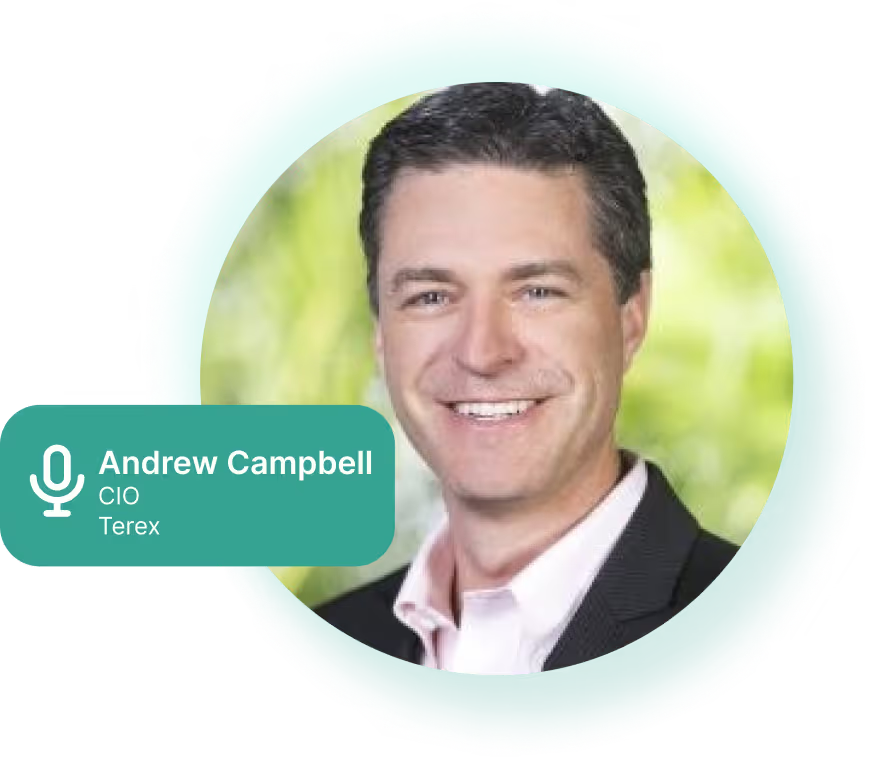
Purposeful Innovation: Avoiding Single-Vendor Lock-in Risk with Andrew Campbell, CIO at Terex Corporation
Andrew talks with us about a number of topics, including the concept of purposeful innovation at Terex, the drawbacks to single-vendor environments, his reasons for being a servant leader, and more.
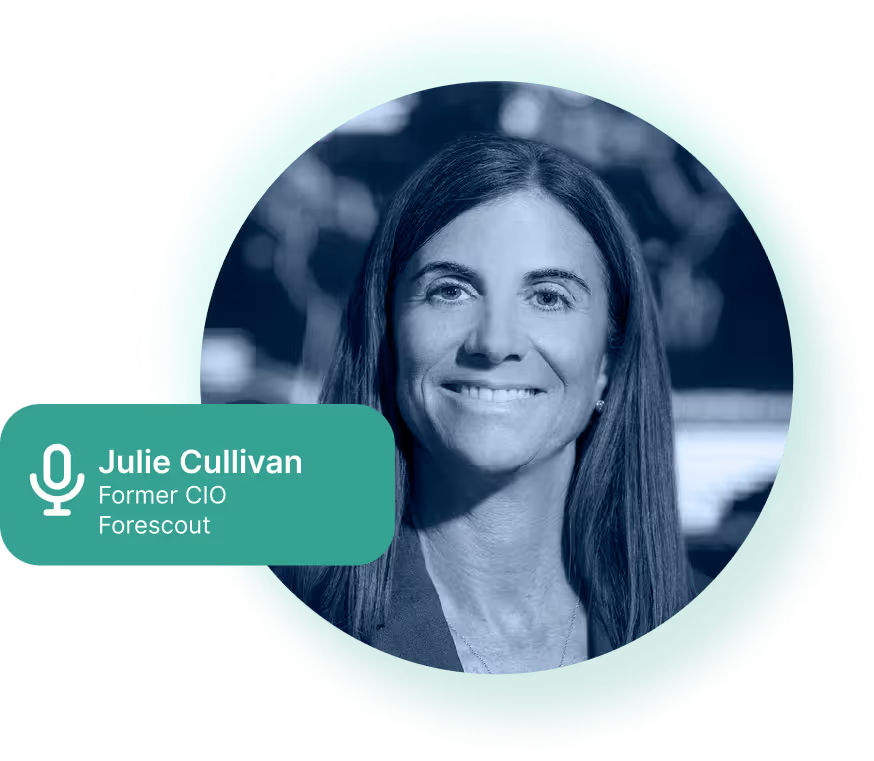
CIO Leadership Advice: Lessons from Sales and Go-to-Market with Julie Cullivan, Former Forescout CIO
Julie (Board Director at Axon, HeartFlow, and AaDya) joins us to share how she handled leading both technology & people at Forescout, why she took the leap to become a first-time CIO at FireEye, what she learned from her go-to-market roles at McAfee & Autodesk, and more.
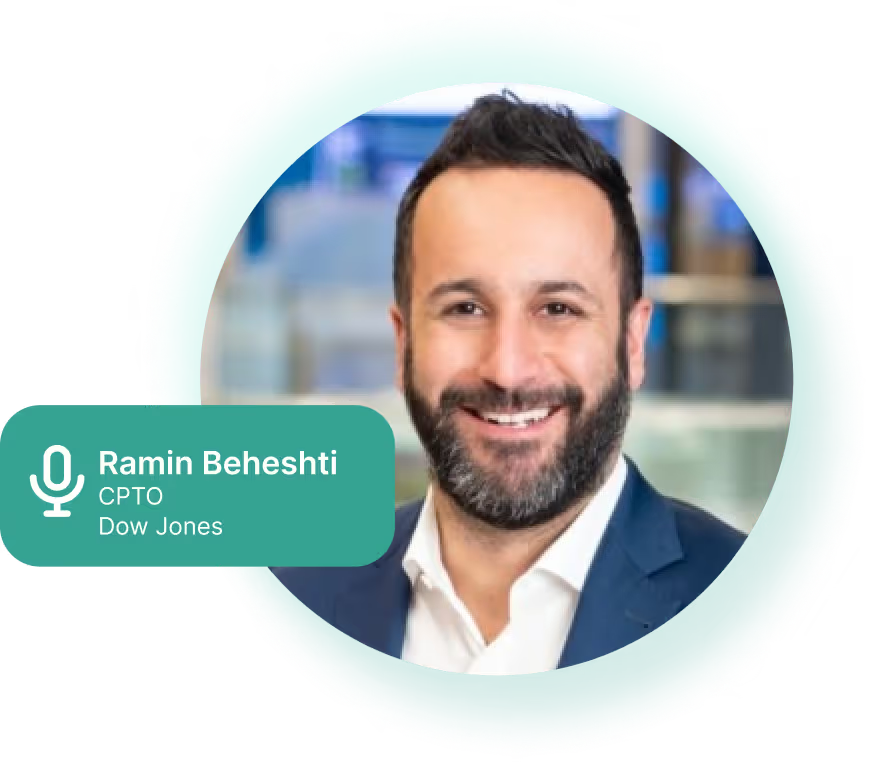
CIO to CPTO Transition: Shaping Product Culture and Curiosity with Ramin Beheshti, CPTO at Dow Jones
Ramin is the Chief Product & Technology Officer at Dow Jones, publisher of The Wall Street Journal, Barrons, Marketwatch, and more. He talks leadership lessons, the value of curiosity, his approach to working with startups, and more.
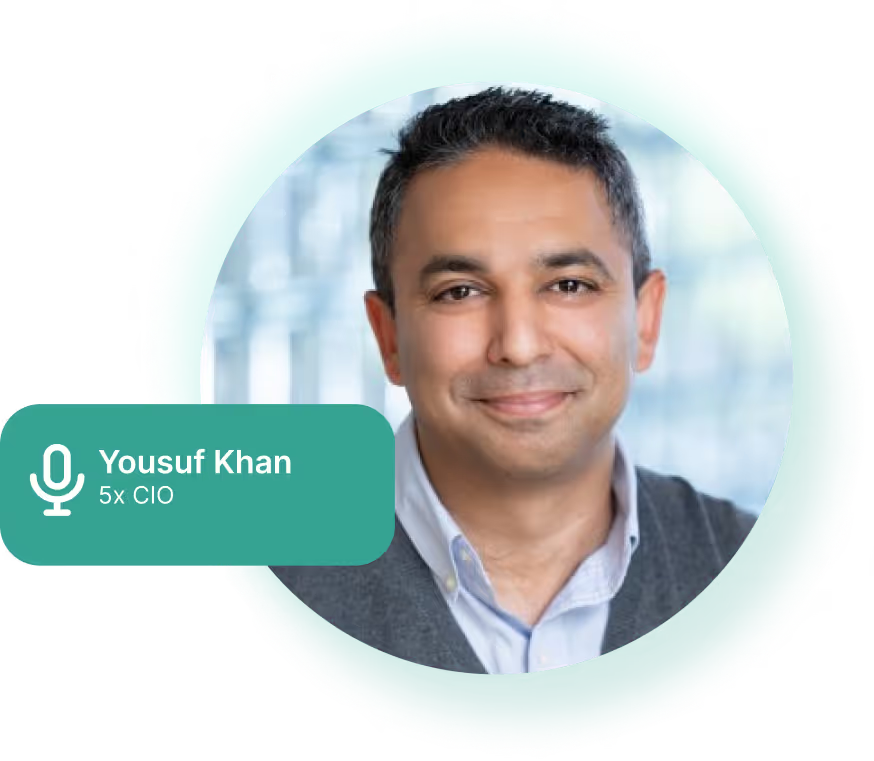
CIO to VC: Evaluating Startup Tech and Early-Stage Bets with Yousuf Khan, Former 5x CIO
Our first guest is Yousuf Khan, who discusses what he learned on his journey from accidental CIO at companies like Automation Anywhere, Moveworks, and Pure Storage to unconventional VC at Ridge Ventures.