In enterprise search, self-hosted is the deployment architecture where the entire stack (ingestion connectors, the search index, the embedding model, the Retrieval-Augmented Generation (RAG) orchestration, and optionally the large language model itself) runs inside the customer's own infrastructure rather than in a vendor's cloud. For organizations in regulated industries, that architectural choice has stopped being a deployment preference and started being a procurement gate. It’s the difference between a vendor that promises not to misuse your data, and a vendor that architecturally cannot see it.
This guide covers what self-hosted enterprise search means, how it differs from SaaS, on-premise and self-managed deployments, new risks the rise of LLM-powered features introduces to make this architectural choice more urgent in 2026, the four kinds of control a self-hosted deployment gives the customer back, where self-hosted enterprise search fits against alternatives like Glean, Coveo, and Elastic, and the architectural reasons Atolio was built to be fully self-hosted from day one.
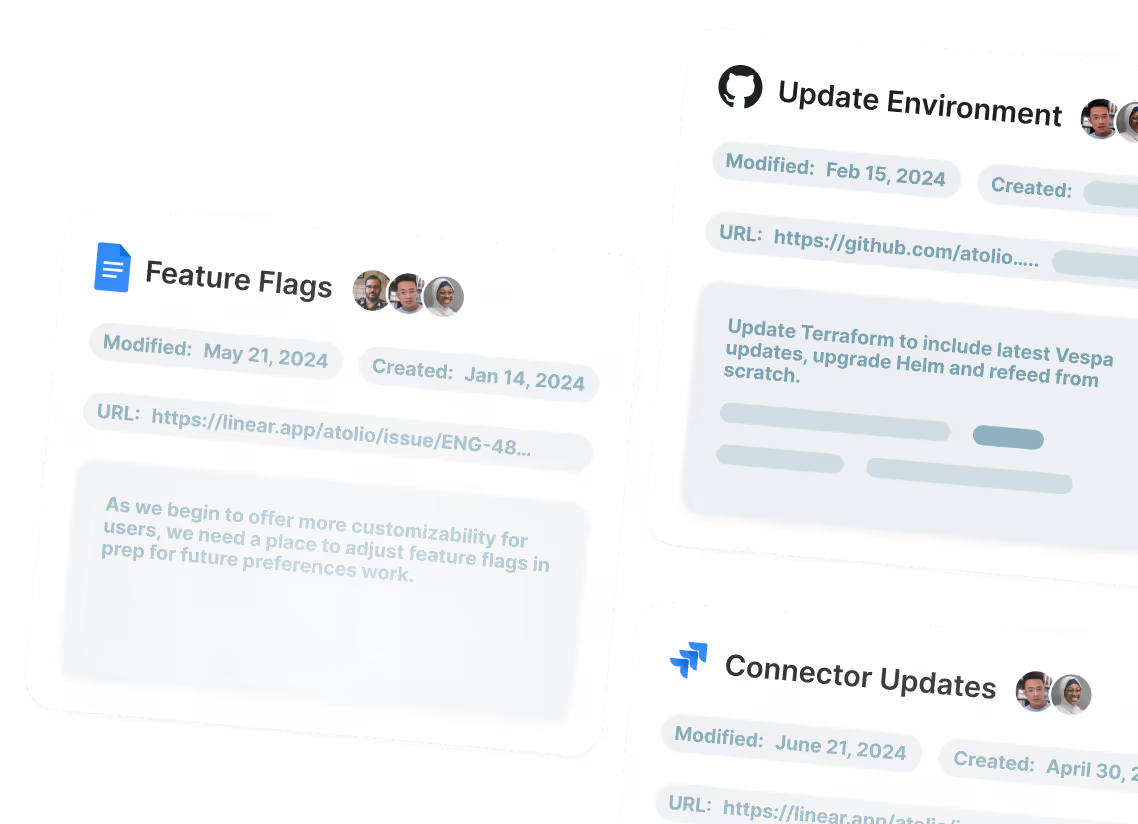
Enterprise search itself has matured beyond keyword lookup. Modern platforms combine vector search, LLM integration, permission-aware indexing, and AI-driven answer generation across the most sensitive systems an organization runs: customer records in Salesforce, source code in GitHub, clinical notes in an electronic health record system, board materials in SharePoint, payroll data in the human resources platform, and the running conversation in Slack that connects them all.
To deliver useful answers, an enterprise search platform has to ingest the data inside those systems. That ingestion is the moment a procurement question turns into a compliance question. Where, exactly, does this data go to be parsed, embedded, indexed, and queried? Who has technical access to it during that process? And what happens when a RAG pipeline starts feeding it into a third-party large language model?
For most organizations in regulated industries, those questions are no longer a preference. They are the entire evaluation. And the answer increasingly depends on a single architectural choice: is the platform Software-as-a-Service (SaaS), or is it self-hosted?
What Self-Hosted Enterprise Search Actually Means
Self-hosted enterprise search runs the entire stack inside the customer’s network. That includes ingestion connectors, the search index, the embedding model, the RAG orchestration layer, and (optionally) the large language model used to generate answers. Nothing leaves your Virtual Private Cloud (VPC), region, or air-gapped enclave unless you explicitly route it out.
.avif)
It is worth distinguishing self-hosted from a few terms it gets used interchangeably with:
- On-premise traditionally meant running on hardware in your own data center. Self-hosted is broader: it includes on-premise, your own VPC in a public cloud (Amazon Web Services, Microsoft Azure, Google Cloud Platform), sovereign-cloud regions like AWS GovCloud or Azure Government, and air-gapped enclaves with no internet egress.
- Self-managed typically means the customer operates and maintains the platform themselves, with or without vendor support. Self-hosted platforms can be self-managed or vendor-managed inside the customer’s environment.
- Private cloud is a deployment model where shared infrastructure is dedicated to a single customer. It overlaps with self-hosted but is not the same: a “private cloud” offering that still runs in the vendor’s account is closer to a SaaS deployment in terms of the trust boundary.
The defining property of self-hosted enterprise search is that the customer, not the vendor, controls the infrastructure boundary. Everything else (the deployment automation, the connector library, the user interface, the model selection) is downstream of that single decision.
The conversation matters more in 2026 than it did even two years ago. A 2025 Gartner forecast cited by IOMETE predicts that more than 75% of enterprises will have a digital sovereignty strategy by 2030, and search infrastructure (the layer that touches every other sensitive system) sits at the top of that strategy's priority list.
SaaS Enterprise Search Has an Indexing-Phase Visibility Problem
Even when a SaaS enterprise search vendor commits contractually, not to train models on customer data, the indexing phase still requires the vendor’s infrastructure to read, parse, chunk, and embed every document the platform connects to. Cleartext content (and the metadata attached to it) passes through vendor-managed systems during ingestion, regardless of how strong the encryption-at-rest and encryption-in-transit configurations are downstream.
Specifically, in a typical SaaS enterprise search deployment:
- Cleartext content passes through the vendor’s network during parsing and embedding. Encryption protects the data in motion and at rest, but the parsing step itself requires the cleartext to be available to vendor-controlled code. That cleartext includes Personally Identifiable Information (PII), Protected Health Information (PHI), and any other regulated fields the source documents contain.
- Embeddings are not fully reversible, but the 2023 paper "Text Embeddings Reveal (Almost) As Much As Text" by Morris, Kuleshov, Shmatikov, and Rush demonstrated that vector representations can be inverted to recover substantial portions of their source text. Treating embeddings as a privacy boundary is a mistake.
- Metadata (file paths, owners, timestamps, Access Control List (ACL) changes) is sometimes more sensitive than the content itself. A document titled “Q4_Layoffs_Final.docx” is a leak even before anyone opens it.
- Query logs reveal what employees are searching for. Trending searches for “severance package” or “acquisition target” are themselves regulated signals.
This is the part of the SaaS enterprise search story that often gets understated in vendor marketing.
Most enterprise SaaS platforms can credibly promise they do not train on your data. Very few can credibly promise that the vendor’s infrastructure does not see your data, because seeing the data is what indexing requires.
For a healthcare system handling PHI under a Business Associate Agreement, or a fintech indexing customer Know Your Customer (KYC) documents under Payment Card Industry Data Security Standard (PCI DSS) and System and Organization Controls 2 (SOC 2) controls, “zero vendor visibility” is a much easier sell to the Legal team than “the vendor encrypts the data.” The shift in framing is from “what the vendor promises not to do” to “what the vendor architecturally cannot do.” PII and PHI exposure is the most common reason an otherwise-approved enterprise search vendor gets rejected in regulated procurement.
The volume of exposure has also stopped being theoretical. A 2025 LayerX study found that 77% of enterprise employees using AI tools had pasted company data into a chatbot query, and 22% of those instances included confidential personal or financial data. Multiply that by every employee with access to a SaaS search bar that fronts a large language model, and indexing-phase exposure stops being an edge case and starts being a procurement gate.
LLM-Powered Search Introduces a New Risk Layer
Generative answers raise the stakes again. LLM features amplify SaaS enterprise search exposure in three ways:
- user prompts include sensitive context,
- embeddings encode proprietary semantics in ways that can leak under inversion attack, and
- the model providers themselves may sit outside the customer’s compliance boundary.
Prompt injection is now the #1 OWASP Top 10 risk for LLM Applications (2025) and has been observed in over 73% of production AI deployments audited during 2025 security reviews. Preventing LLM data leakage in enterprise search is now a board-level concern rather than a vendor-side feature request. The recent incident pattern makes the abstract risk concrete:
- Between July and August 2025, NSFOCUS Security Lab documented multiple LLM data leakage incidents tied to prompt injection. The incidents exposed chat records, credentials, and third-party application data.
- In May 2025, research from Obsidian Security demonstrated that OpenAI's ChatGPT connector for Google Drive and SharePoint was exploitable via indirect prompt injection embedded in indexed documents. A poisoned document, once indexed, could exfiltrate sensitive context the moment a user queried near it.
- In January 2026, Varonis disclosed the “Reprompt” attack against Microsoft Copilot Personal, enabling single-click data exfiltration after a user clicked a legitimate Microsoft link.
This leaves SaaS enterprise search customers exposed to a stack of risks that are difficult to mitigate contractually: indirect prompt injection from poisoned documents that the vendor’s indexer happily processes, cross-tenant data leakage through shared cloud infrastructure; third-party LLM provider incidents outside the customer’s compliance perimeter, and quiet vendor-side feature changes that alter what data gets routed to which model. None of these failure modes are hypothetical, and none of them are addressable by an addendum to a Data Processing Agreement. They are addressable by removing the third party from the data path.
Here, self-hosted architecture has an edge over alternatives.
What Self-Hosted Gives You Back: Four Kinds of Control
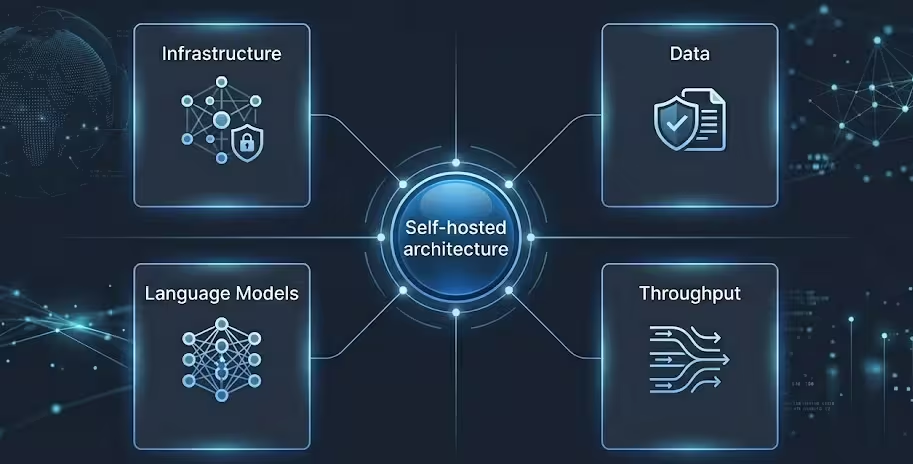
The case for self-hosted enterprise search is not “more security in general.” It is four specific dimensions of control that a SaaS deployment cannot match: control over the infrastructure, control over the data, control over the language models, and control over throughput and cost. Each of these maps directly to a procurement question regulated buyers raise in every evaluation.
Control Over the Infrastructure
A Kubernetes-native enterprise search platform can deploy across Amazon Web Services (AWS), Microsoft Azure, Google Cloud Platform (GCP), Red Hat OpenShift, and AWS GovCloud, and into air-gapped environments with no public internet access. The cluster can be tuned to client-specific compliance requirements: Federal Risk and Authorization Management Program (FedRAMP) High, Department of Defense Impact Level 5, Health Insurance Portability and Accountability Act (HIPAA)-eligible regions, and European Union data residency boundaries under the General Data Protection Regulation (GDPR). Because the data plane never crosses the perimeter, no document, embedding, or prompt leaves your network without explicit routing.
This is what “100% data residency” actually requires in practice: not a vendor’s promise to keep data in a region, but a deployment that physically cannot send it anywhere else. The same architecture is what makes enterprise search for OpenShift environments, deploying enterprise search on GovCloud, and enterprise search with air-gapped support buildable rather than aspirational.
Control Over the Data
With SaaS, documents, metadata, and derived artifacts (embeddings, summaries, query logs) are typically processed outside your network. Even with encryption and tenant isolation, the vendor can technically access cleartext during processing, which is why customers fall back on contractual assurances. A self-hosted deployment makes the boundary technical: the vendor never has visibility into PII, PHI, or any artifact derived from them.
Native ACL syncing runs inside the network against the source systems (SharePoint, Confluence, Salesforce, Slack, GitHub, Box, Google Drive), so the search index never returns documents a given user could not already see in the source. Permission-aware indexing for Zero Trust is enforceable at the architectural level rather than negotiated in a Master Service Agreement. Combined with no third-party data processing, this is the architecture that makes secure AI for regulated industries actually deliverable rather than aspirational.
Control Over the Language Models
Embeddings can be calculated on-premise using self-hosted models on the customer’s own Graphics Processing Unit (GPU) compute. For answer generation, a self-hosted enterprise search platform that is not tied to a single large language model provider gives you a choice: a commercial Application Programming Interface (API) such as OpenAI, Anthropic, or Google when broad capability is the priority, or an on-premise large language model (Llama, Mistral, Qwen, or a private fine-tune) when zero third-party data processing is required.
Bring-Your-Own-Model (BYOM) enterprise search is the difference between adopting the best model each quarter and being locked into a single vendor’s roadmap. Given how quickly the frontier moves, that flexibility is the difference between a platform that ages well and one that becomes a switching-cost trap.
Control Over Throughput, Latency, and Cost
SaaS large language model providers like OpenAI and Anthropic enforce strict rate limits (typically a few thousand requests per minute and tens to hundreds of thousands of tokens per minute, depending on tier) and have occasional incidents. A self-hosted model on the customer’s own GPUs gives you guaranteed throughput at a known cost. That matters when enterprise search becomes the substrate for agentic workflows that fan out into hundreds of large language model calls per user task.
Self-hosted also avoids the egress cost trap. A 2024 CloudOptimo analysis puts cloud egress fees at 5 to 20 cents per gigabyte, and documents a case where egress costs scaled 15x as the user base grew while compute and storage costs scaled only 3x. A November 2025 survey reported by Virtualization Review found that 55% of IT leaders cite egress and data transfer costs as the single biggest barrier to switching cloud storage providers. Latency-free internal search for large-scale VPCs is not just a performance argument. It is a cost argument, and increasingly a procurement-defining one.
How the Vendor Landscape Compares
Most enterprise search products sit somewhere on a spectrum from SaaS-only to fully self-managed. Glean and Coveo anchor the SaaS end. Elastic anchors the toolkit end. A handful of newer platforms, including Atolio, sit in the middle: a packaged self-hosted product, not a build-your-own kit.
The four columns below (deployment model, data residency, Zero-Trust architecture, and large language model flexibility) are the dimensions that decide most procurement conversations in regulated industries.
Glean's on-premises offering is more accurately described as hosted-SaaS in a customer Virtual Private Cloud (VPC) than as traditional self-hosted. In its Customer Hosted model (previously Cloud-Prem), Glean deploys an isolated tenant inside the customer's AWS, Azure, or GCP environment. The data storage layer sits in the customer's network, but the Glean frontend remains a SaaS web application connecting to those private backends, and Glean operates the deployment as a managed service. Glean's architecture is a tightly integrated system rather than a set of containerized services, so customers cannot manually deploy, patch, or modify any part of it. For buyers whose compliance posture requires the vendor to have zero operational access to the cluster, that distinction is the entire procurement question.
Self-hosted enterprise search platforms sit in the Goldilocks zone: the ease of a product like Glean (without the security risks) with the residency of a toolkit like Elastic (without the heavy lifting). For teams searching specifically for Glean alternatives with on-premise deployment, or for the best Glean alternatives for regulated industries, the deployment and data residency columns are where the evaluation starts.
When Self-Hosted Is the Right Choice (and When It Isn’t)
Self-hosted enterprise search is not the right answer for every organization. It is the right answer when one or more of the following is true:
- The compliance team requires zero third-party data processing as a contractual baseline. This is increasingly common in healthcare, financial services, defense, and pharmaceutical Research and Development.
- The data sits in air-gapped, sovereign-cloud, or regulated environments such as AWS GovCloud, Azure Government, or on-premise data centers governed by FedRAMP High, Department of Defense Impact Level 5, or International Traffic in Arms Regulations (ITAR).
- The expected usage volume would otherwise hit SaaS rate limits or trigger material egress costs. This includes agentic workflows that fan out into many large language model calls per user task and high-volume internal search across multi-region Virtual Private Clouds.
- The organization needs BYOM flexibility to adopt new models as they ship, without renegotiating a SaaS contract per change.
The pattern shows up most consistently in:
- Healthcare systems indexing patient charts, lab results, clinical notes, and human resources records. Business Associate Agreement exposure and PHI handling under HIPAA make vendor visibility a Legal blocker.
- Financial services firms with insider-trading walls, Material Non-Public Information (MNPI) controls, customer KYC documents, and transaction histories. Self-hosted RAG for sensitive data is often the only architecture that clears compliance under the Gramm-Leach-Bliley Act and PCI DSS controls.
- Federal agencies and defense contractors with classified or controlled environments, FedRAMP High, Department of Defense Impact Level 5 and Impact Level 6 workloads, and export-controlled data. Sovereign AI enterprise search running on GovCloud or in air-gapped enclaves is the baseline requirement.
- Critical infrastructure operators in utilities, energy, and manufacturing where operational technology data cannot transit a public cloud.
- Pharmaceutical Research and Development teams with trial data, intellectual-property-bearing chemistry, and regulatory submissions to the Food and Drug Administration or European Medicines Agency.
Beyond the compliance argument, self-hosted is also the natural choice for engineering organizations that want enterprise search for OpenShift environments, want a self-hosted vector database for enterprise search rather than another managed service, or are trying to keep an internal LLM strategy coherent across product lines.
If none of the above is true (a mid-market software company with no regulated data, all systems already in a major public cloud, and no air-gapped or sovereign requirements) SaaS enterprise search will typically be faster to stand up and easier to operate.
Why Atolio Was Built Self-Hosted
Atolio was built self-hosted from day one because the data sovereignty story is the only one that holds up under enterprise legal review. Atolio deploys into your Kubernetes cluster (AWS, Azure, GCP, OpenShift, GovCloud, or fully air-gapped), runs embedding models on your GPUs, syncs ACLs natively against source systems, and never sees your documents, your queries, or your users’ identities.
Concretely, that means connectors run in-network, permission-aware indexing happens against source-system ACLs, embeddings are computed locally, and the large language model call is the one place where you choose whether to send anything to a third-party API. You can opt out of that entirely with a self-hosted model if your compliance posture requires it. The answer to “does the vendor see our PII?” becomes “no, ever” rather than “no, except during indexing.” This is exactly why Atolio was built this way: for the buyer whose Legal team will not sign on “trust us, we encrypt it” but will sign on “the vendor has zero visibility.”
The same architecture is what backs Atolio’s work with federal agencies, including the U.S. Air Force, and what underpins the security architecture documented in detail on the product.
Self-Hosted Enterprise Search FAQs
1. Is self-hosted enterprise search the same as on-premise?
Not exactly. On-premise traditionally meant running on hardware in the customer’s own data center. Self-hosted is broader: it includes on-premise, the customer’s own VPC in a public cloud, sovereign-cloud regions like AWS GovCloud or Azure Government, and air-gapped enclaves with no internet egress. The defining property is that the customer controls the infrastructure boundary, not the vendor.
2. Can a SaaS provider truly guarantee data residency?
A SaaS provider can guarantee a storage region but not full data sovereignty, because the SaaS model relies on centralized infrastructure (shared compute, multi-tenant control planes, global update pipelines) that is incompatible with the technical guarantees regulated buyers increasingly require. Self-hosted deployments are the only architecture that provides provable, technical residency. The data physically cannot leave the boundary the customer controls.
3. Does self-hosting force me to give up modern AI features?
No. A self-hosted RAG deployment can use the same vector search, hybrid retrieval, agentic orchestration, and frontier large language models that SaaS platforms use. The difference is that the customer chooses whether each layer runs locally or calls a third-party API, and the decision can change per use case (commercial LLM for general question-answering, on-premise LLM for anything touching regulated data).
4. Isn’t self-hosted more expensive than SaaS?
Self-hosted has higher infrastructure ownership but typically lower total cost at scale, especially when the comparison accounts for egress fees, per-seat SaaS pricing (often $50 or more per user per month with 100-user minimums), and the compliance premium SaaS vendors charge for FedRAMP-eligible or HIPAA-eligible tiers. SaaS pricing scales linearly with seats; self-hosted scales with data volume and query load, which is usually the more favorable curve for a platform that becomes the substrate for internal AI.
5. How does self-hosted handle LLM updates and model improvements?
Through BYOM. A self-hosted enterprise search platform that is not tied to a single large language model provider lets the customer swap models as new ones ship. If a new open-weights model outperforms last quarter’s choice on the customer’s internal evaluation set, the customer deploys it without renegotiating a SaaS contract or waiting on a vendor roadmap.
6. How does self-hosted enterprise search support Zero Trust?
Zero-Trust enterprise search architecture starts with permission-aware indexing: the index never returns a document a given user could not already see in the source system. Self-hosted deployments enforce this at the architectural level by running native ACL syncing inside the customer’s network against source systems like SharePoint, Confluence, Salesforce, and Slack. Combined with no third-party data processing and customer-controlled audit logs, this is what makes Zero Trust enforceable in code rather than in contract language.
7. What about open-source enterprise search? Is that the same as self-hosted?
Not necessarily. Open-source projects (Elastic’s open distribution, OpenSearch, Vespa) are self-hostable by definition, but they are search engines and components, not packaged enterprise search products. They require the customer to build the connector library, the permission-aware indexing layer, the RAG orchestration, the user interface, and the LLM integration. A packaged self-hosted product runs on the customer’s infrastructure but does not require the customer to build the product.
Where Self-Hosted Enterprise Search Goes from Here
Enterprise search has moved from a productivity tool to the substrate that every internal AI workflow runs on. That changes the threat model, and it changes the buying conversation. For regulated buyers in 2026, the question is no longer “which vendor has the best search relevance” but “which architecture lets us prove, in writing and in code, that our data never leaves the boundary we control.”
That is the case for self-hosted, and it is the architectural decision behind every other capability a serious enterprise search platform delivers. See how Atolio’s self-hosted architecture works, or book a demo to walk through a deployment in your environment.