Google Knowledge Catalog is the rebranded, Gemini-powered evolution of Dataplex Universal Catalog, a metadata management and AI-context service for the data assets inside Google Cloud. It unifies structured, unstructured, and SaaS data into a governed, agent-ready context graph for humans and AI agents. It's essential infrastructure for GCP data teams. It's also explicitly not a workplace knowledge discovery tool, which means it answers "what data do we have?" but not "what does my company know?"
At Google Cloud Next '26, Google celebrated its rebrand of Dataplex Universal Catalog as Google Knowledge Catalog, a name that signals a broader ambition: move beyond passive metadata registries and become the "universal context engine" that grounds AI agents in enterprise truth.
If you're evaluating the announcement, sorting through the implications of the rebrand, or trying to figure out where Knowledge Catalog fits in your enterprise stack, this guide is for you. We'll cover what it is, how it works, what's new, and – importantly – where its scope ends.
What is Google Knowledge Catalog?
Google Knowledge Catalog is a fully managed, Gemini-powered metadata management and data discovery service built on top of Google Cloud Dataplex. It serves as a centralized, searchable catalog of an organization's structured, unstructured, and SaaS data assets – BigQuery tables, Cloud Storage files (including PDFs, images, docs), Agent Platform models, pipelines, dashboards, and federated SaaS metadata from systems like SAP, Salesforce, and ServiceNow – and layers AI-generated context on top so data teams and agents can find, understand, trust, and govern that data.
Think of it as the Yellow Pages for your GCP data infrastructure, now with an AI brain.
- Primary audience: Data engineers, analysts, and scientists, as well as AI developers working inside the Google Cloud ecosystem.
- Primary job to be done: Make your data estate discoverable, governable, and safe enough for AI agents to reason over without hallucinating.
Why Google Renamed Dataplex to Knowledge Catalog
The rebrand reflects a strategic shift, not just a marketing one. As organizations race to deploy generative AI and autonomous agents, those agents need context like schemas, relationships, definitions, lineage, and policies to produce accurate, grounded responses. A static, passive metadata registry no longer cuts it.
Knowledge Catalog repositions the product from a conventional catalog into an active, AI-powered context graph that continuously curates metadata, business logic, and data relationships into a unified source of truth for humans and agents alike. Existing Dataplex deployments, APIs, and client libraries remain operational; the migration is transparent.
How Google Knowledge Catalog works: the three pillars
Knowledge Catalog is built on three foundational capabilities.
1. Aggregation: unifying context across your data estate
Knowledge Catalog automatically ingests technical metadata from first-party Google Cloud services (BigQuery, AlloyDB, Spanner, Cloud SQL, Firestore, Looker, Pub/Sub, Cloud Storage, Agent Platform) and federates with third-party catalogs like Atlan, Collibra, Datahub, Ab Initio, and Anomalo. Through Google Cloud Lakehouse and enterprise connectivity previews, it also reaches into SaaS systems like Palantir, Salesforce Data360, SAP, ServiceNow, and Workday.
The goal: a single, governed map of every data asset across your organization.
2. Enrichment: generating meaning through continuous learning
Catalogs alone don't create understanding. Knowledge Catalog uses Gemini to:
- Automatically generate natural-language descriptions and business glossaries
- Extract entities and relationships from unstructured content in Cloud Storage
- Infer business intent from schemas, query logs, and BI semantic models
- Produce verified SQL patterns ("golden queries") that capture complex business logic
- Provide semantic guardrails that help prevent agents from hallucinating joins and logic
3. Retrieval: high-precision, secure context for agents
Once the catalog is enriched, it becomes a query layer. Knowledge Catalog exposes:
- High-precision semantic search using Google's hybrid search stack
- Access-control-aware retrieval that respects source-system permissions
- Model Context Protocol (MCP) integrations, both remote and local, so AI agents in Gemini Enterprise, Agent Platform, LangChain, Agent Development Kit (ADK), or custom frameworks can pull trusted context at runtime
Underneath, the service continues to support the governance primitives data teams need at scale, including data lineage, data profiling, auto data quality, and policy-tag-based column-level security.
Key Features at a Glance
Who Benefits, and Who Doesn't
Knowledge Catalog shines for:
- Data engineers managing GCP-centric pipelines
- Data stewards enforcing governance at scale
- AI/ML developers grounding agents in governed enterprise data across structured sources, unstructured files, and connected SaaS systems
- Analytics teams discovering and trusting data before querying it
But here's the important caveat. Knowledge Catalog is a data catalog: it indexes your data infrastructure. It is not a workplace knowledge discovery tool. It won't help a product manager find the Slack thread where a pricing decision was made, surface the Notion doc explaining a launch strategy, or point a new hire to the person in the org who owns a given process.
That's a different problem, and a different kind of product.
Where Knowledge Catalog Fits (and Where It Doesn't)
To understand the gap, it helps to compare the two categories side by side.
If the question is "what data do we have, and how do we govern it for AI?", Knowledge Catalog is a best-in-class answer inside a Google Cloud estate.
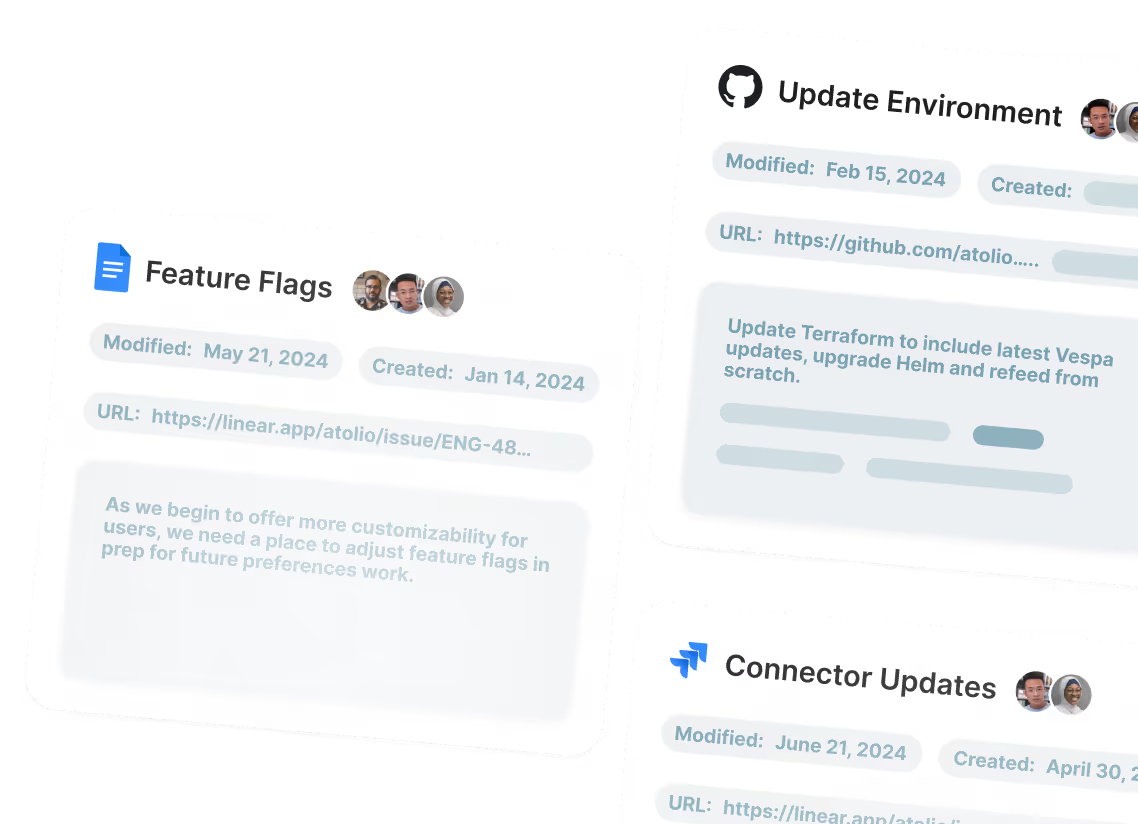
If the question is "what does my company actually know across every tool, conversation, and document, and who knows it?", that's the problem Atolio was built for.
These two problems frequently coexist. A mature enterprise in 2026 needs both: a governed semantic layer for its data estate and a permission-aware discovery layer for the tacit knowledge living in Slack, Confluence, Jira, Salesforce, Zoom transcripts, email, and everywhere else work actually happens.
Limitations to plan for
A few practical considerations:
- GCP-first gravity. Knowledge Catalog's deepest integrations are with Google Cloud services. Multi-cloud and non-GCP environments work, but expect setup friction.
- Setup complexity. Because it sits on Dataplex, it's a sophisticated infrastructure product that typically requires data-engineering resources to configure well.
- Quota limits. Standard GCP API quotas apply to context retrieval and metadata extraction operations.
- Scope of "knowledge." Despite the name, Knowledge Catalog governs the data plane, including unstructured files and SaaS metadata, but does not index workplace knowledge like Slack threads, meeting transcripts, email, tickets, or people expertise.
- Pricing. Pricing is pay-as-you-go based on usage, which can be hard to plan for.
Frequently Asked Questions
1. Is Google Knowledge Catalog the same as Dataplex?
Yes. Knowledge Catalog is the new name for Dataplex Universal Catalog. Core Dataplex capabilities like data discovery, lineage, quality, and business glossaries are unchanged and supported. APIs and gcloud dataplex commands continue to work.
2. Does Knowledge Catalog replace my enterprise search tool?
No. Knowledge Catalog indexes your data estate – structured, unstructured, and SaaS data – for agent-ready context and governance. It does not index workplace knowledge like Slack threads, email, meeting transcripts, tickets, or the contributor graph of who knows what. Enterprise knowledge discovery platforms serve that role and typically sit alongside a data catalog.
3. Does Knowledge Catalog work outside Google Cloud?
It federates with third-party catalogs and some SaaS systems, but its deepest value is realized inside GCP. Non-GCP data estates face more configuration overhead.
4. How does Knowledge Catalog relate to AI agents?
Through MCP tools, Context APIs, and pre-verified "golden queries," agents retrieve grounded enterprise context at runtime, reducing hallucinations on data-retrieval and data-reasoning tasks.
The Takeaway
Google Knowledge Catalog is a powerful evolution of Dataplex: a Gemini-powered context graph that makes structured data discoverable, governable, and safe for agents to reason over. For Google Cloud–centric data teams building agentic workflows, it's essential infrastructure.
But it solves one half of the enterprise knowledge problem. The other half – the conversations, decisions, docs, and expertise that shape how work actually gets done – lives outside the data stack entirely. For that, organizations need a purpose-built enterprise knowledge discovery layer that indexes the full workplace graph, respects source-system permissions, and connects people to what they need to know.
The two are complementary, not competitive. Together, they give your agents – and your employees – the complete picture.