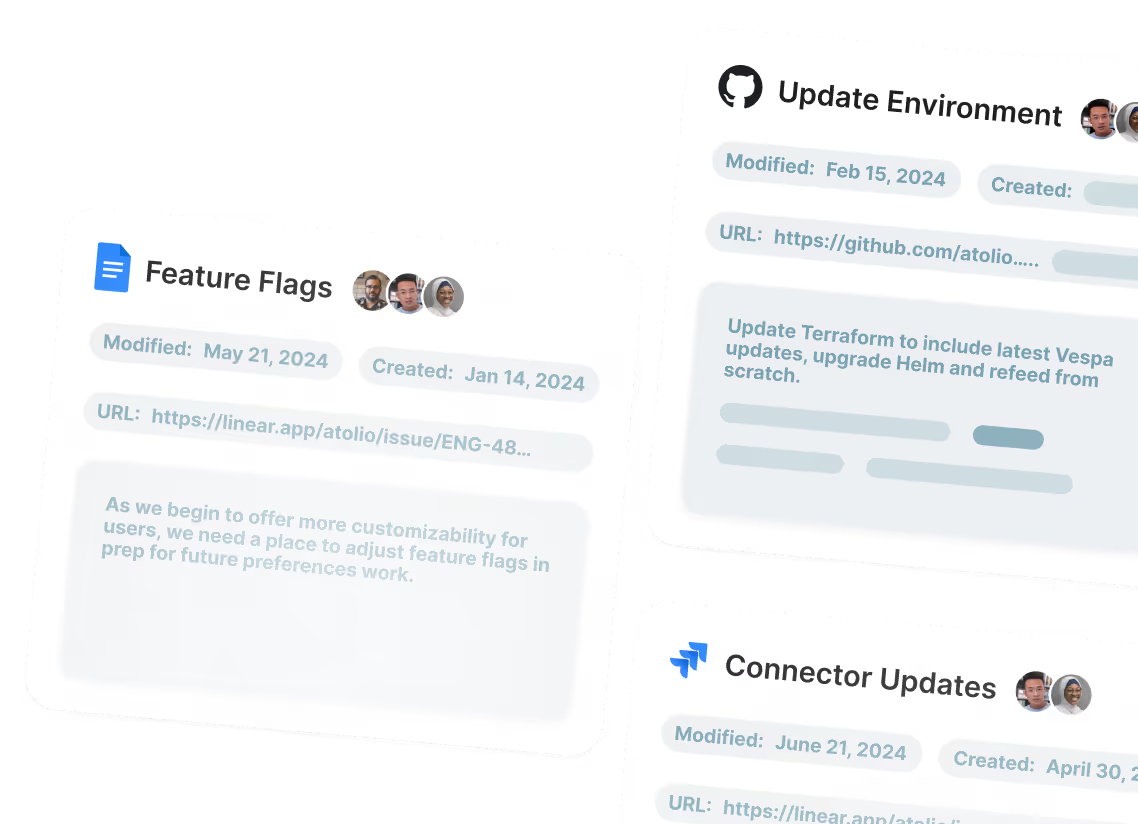

Picture the knowledge infrastructure of a typical organization in 2026. Sales runs in Salesforce. Engineering lives in GitHub, Jira, and Confluence. Support operates in its ticketing system. Legal works in a separate document management platform. HR has its own records system. Finance has its reporting stack. And cutting across all of them: Slack, Google Drive or SharePoint, email, and whichever wiki was most recently adopted.
Each of those systems has its own search. None of them can see the others.
The customer contract lives in the CRM. The context behind why that deal was structured the way it was lives in Slack. The legal precedent relevant to the renewal sits in the document management platform. The product team's notes on the customer's technical requirements are in Confluence. A new account manager preparing for a renewal call has to find all of this separately – if they can find it at all. And this is a single, routine task.
A 2023 Gartner report found that knowledge workers use an average of 11 applications to do their jobs. McKinsey Global Institute's 2023 ‘The Economic Potential of Generative AI’ report estimates that knowledge workers spend 20-30% of their time searching for and processing information. And a 2023 Quickbase survey corroborates the scale: 70% of employees report spending more than 20 hours per week chasing information across different technologies rather than doing the work they were hired to do.
The frustrating part is that most of this institutional knowledge exists. It was created, and it lives somewhere. The problem is that it isn't reliably accessible to the people who need it, at the moment they need it, in the context of how they work.
And increasingly, that baseline is no longer enough. Search and retrieval – finding the right document quickly – has become table stakes. What employees now expect is something closer to the experience they have with tools like ChatGPT or Claude over public internet data: the ability to ask a question conversationally, get a synthesized answer drawn from across every system their organization uses, understand who internally holds relevant expertise on a topic, and interact with a thread of inquiry across siloed platforms rather than assembling fragments manually. That shift is what makes enterprise search maturity a genuinely strategic question in 2026 in a way it was not five years ago.
Enterprise search maturity is the framework for measuring the gap between what your organization knows and what your people can actually, quickly, and securely access – and then understanding what it takes to close it.
What Enterprise Search Maturity Means
Enterprise search maturity describes how effectively an organization can find, surface, and act on information, knowledge, and context distributed across its tools and systems. This includes not just documents and files, but critical context, nuance, and expertise: who in the organization knows what and who has worked on which problems.
Before large language models, the dominant frame was “Google for work” – finding the right document, almost instantly. That frame is now too narrow. Openkit Conductor's State of Enterprise Search Report (April 2026) finds retrieval-augmented generation (RAG) is projected to grow at a 38.4% CAGR through 2030. This aligns with the structural shift the enterprise search market is undergoing from simple link retrieval to synthesized, knowledge-based answers.
The expectation has moved from “surface the document” to “have a conversation with the organization's knowledge”, with citations, continuity across follow-up questions, and the ability to stitch together fragments from across Microsoft, Google, Salesforce, Atlassian, and every other platform where work actually happens. At high maturity, employees reach the right answer – the document, the decision, the relevant context, the right person – regardless of which system it lives in with security and permissions respected automatically, critical context surfaced, and often a clear sense of what to do next provided. At low maturity, employees know the answer probably exists somewhere in the organization, but cannot reliably reach it without querying multiple systems manually and asking colleagues who might remember.
The gap between those two states is not just a productivity variable (which on its own has exceedingly high costs). It's an AI readiness variable, a decision quality variable, a security variable, and increasingly a competitive one.
Most organizations significantly overestimate their maturity because they have search within each of their tools, and they mistake having the capability for having it work well. The following framework provides a calibration.
The model assesses maturity across four levels:
- Level 1 is Security (data governance and permissions enforcement)
- Level 2 is Integration (cross-system connectivity across the full tool stack)
- Level 3 is Efficiency (search accuracy and relevance good enough that search is the default behavior), and
- Level 4 is Intelligence (AI augmentation that works because the underlying foundation is sound).
The table below summarizes what each stage looks like in practice.
Overview: Enterprise AI Search Maturity Stages
The Four Levels of Enterprise Search Maturity
This maturity model was built from our research with more than 800 organizations spanning financial services, technology, legal, healthcare, manufacturing, and government, at every stage of AI adoption and enterprise search sophistication. From teams just beginning to evaluate their current state to those running sophisticated AI deployments at scale, one pattern emerged consistently: organizations that realize meaningful value from enterprise search and AI investment build from the same foundation, in the same sequence. Organizations that skip levels get stuck.
The model is structured as a hierarchy because each level is a prerequisite for the one above it. You cannot achieve efficient, accurate search without integration across your systems. You cannot meaningfully layer AI on top of search that doesn't work reliably. Most enterprise AI vendors begin their pitch at the top of the hierarchy, while most enterprise buyers find themselves stuck at the bottom.
Level 1 | Security: The Foundation
At this level, the fundamental architecture question gets answered: where does your data live, who can access it, and is that enforced consistently at the search layer?
Security in this context means the solution is self-hosted or on-premise, not on the vendor's cloud. Zero-trust principles are applied. Permissions are enforced: what you can find in search reflects exactly what you are authorized to access in the underlying system, no more and no less. If you do not have access to a folder in Google Drive, its contents should not appear in your search results.
This sounds like a baseline assumption. In practice, it is widely unsolved and often overlooked. A significant portion of enterprise search implementations either route data through a third-party cloud (creating governance and compliance exposure) or surface results the searching user isn't authorized to access (creating data security risk). For organizations in regulated industries like financial services, healthcare, legal, or government, this is not a preference: it is a regulatory requirement.
It is also the prerequisite for everything above it. An AI tool that ignores permissions is not just a security risk. It is a tool your compliance team will eventually shut down. A 2024 Gartner report estimates that poor data governance costs organizations an average of $15 million per year in direct losses. Even a decade ago, IBM's 2016 research put the broader cost of bad data quality in the US alone at over $3.1 trillion annually. The foundation cannot be deferred.
Level 2 | Integration: Spanning the Stack
With a secure foundation in place, the next question is: how much of your organizational knowledge can be reached from a single search interface?
Emerging protocols like MCP (Model Context Protocol) are making it easier to connect AI systems to enterprise tools programmatically. However, MCP addresses connectivity, not governance, and it operates connection by connection rather than delivering a unified, simultaneous view across all systems. True integration means active connectors to the full range of systems where work actually happens: Slack, Google Drive, Microsoft 365, Confluence, Jira, Salesforce, Notion, GitHub, Zendesk, and whatever else defines how your teams operate. It means those connectors work across departments, not just for one team's stack. And it also means search results surface content across all connected systems simultaneously, in a single interface.
Most organizations are partially at Level 2. They've connected some tools to some search interfaces. The gaps tend to cluster at cross-functional seams: the places where a sales rep needs engineering context, a support agent needs product history, or a legal team needs compliance background from a system they didn't build and don't regularly work in.
Those seams are expensive – more expensive than most organizations realize until they take the time to quantify it. The account manager who sends three Slack messages instead of searching, the support agent who escalates because they can't surface the relevant precedent, the engineer who spends an hour reconstructing incident context that exists across six systems; all of these are integration gaps manifesting as productivity and quality loss.
Level 3 | Efficiency: Search That Actually Works
This is the level most organizations believe they're at when they begin evaluating enterprise search solutions. Most are not.
Efficiency means search results are fast and accurate. They are relevant to the person searching, to the context they're in, and to what they actually need, not merely keyword-matched against a corpus of everything. Modern semantic and vector search approaches have raised the baseline for what “relevant” means: a Level 3 system understands intent, not just terminology. The difference between a system that responds to “Q3 renewal strategy” by surfacing the right Confluence pages, Slack threads, and CRM notes simultaneously versus one that returns fifteen documents containing those words is the difference between Level 2 and Level 3. Onboarding time for new employees drops measurably because institutional knowledge is genuinely discoverable. Employees stop asking colleagues for help not because they've given up on search, but because search reliably produces better results faster than any alternative.
There is a less-discussed prerequisite for Level 4 that sits at the top of Level 3: knowledge quality. The accuracy and usefulness of RAG-powered answers depends entirely on how well the underlying knowledge is structured, maintained, and chunked before it is ingested. Organizations that deploy AI on a well-connected but poorly maintained knowledge base – outdated documents, duplicate content, missing context – find that they get Level 4 speed with Level 2 quality, further exacerbating old gaps and errors. Knowledge hygiene is not a technical afterthought; it is what separates Level 4 implementations that build trust from those that erode it.
Level 4 | Intelligence: AI That Has a Foundation to Work From
This is where most enterprise AI vendors begin their pitch: relevant answers instead of just surfacing documents, autonomous agents that act across knowledge sources, AI that understands context and intent rather than just keywords.
Level 4 is real and achievable – but only on top of a functional Level 1-3 foundation. AI-augmented enterprise search is only as good as the foundation beneath it: what it can access, and how trustworthy the underlying data quality and permission structure is.
The architecture that makes Level 4 possible is retrieval-augmented generation (RAG), a design pattern where AI models ground their responses in retrieved organizational knowledge rather than relying solely on training data. RAG is what gives Level 4 answers their two most important properties: they are drawn from your current organizational knowledge, and they are attributable, with citations that let users verify and trace every claim. As enterprise AI concerns increasingly center on accuracy and accountability, citation capability is rapidly becoming the architecture default rather than a differentiator.
At full Level 4, enterprise search functions as a context layer: the infrastructure that gives every AI tool in your stack access to the full, governed, current state of what your organization knows. This includes not just documents and messages, but also the collaboration graph: who in your organization holds expertise on a given topic, who works closely with whom, and where institutional knowledge actually lives.
At the leading edge of Level 4, the system becomes proactive. Rather than waiting to be queried, it surfaces relevant knowledge based on what a user is currently working on: flagging a relevant precedent before a meeting, connecting a new hire to an expert whose prior work overlaps with their current project, or alerting a team that a decision they're about to make was already made and reversed eighteen months ago. This is the compounding return on a mature knowledge infrastructure: the organization stops losing value it already created.
BCG's 2025 AI Value Gap analysis finds that future-built firms – those successfully compounding AI returns – are more than three times as likely to operate a central, integrated AI platform as the backbone for their deployment. More than 50% operate on a single enterprise-wide data model, compared with approximately 4% of their stagnating peers. They are also three times as likely to enforce enterprise-wide data policies through central governance – the organizational expression of Level 1 maturity applied at scale.
Meanwhile, OpenAI's 2025 "State of Enterprise AI" report finds that 75% of enterprise workers report AI has improved the speed or quality of their output, with active users attributing 40-60 minutes of time saved per active day to AI tools. Those returns accrue to organizations with the Level 1-3 foundation already in place. Deploying AI on a Level 1-2 foundation produces AI-speed access to a fraction of your knowledge base, with compounding reliability and trust problems.
The organizations seeing the highest returns from AI investment share a common characteristic: they treat their knowledge infrastructure as a product, not a byproduct. They maintain it, govern it, and build on it continuously. The context layer doesn't emerge from a single deployment. It compounds in value as more sources are connected, more permissions are enforced, and more employees interact with it in ways that surface what the organization actually knows.
Level 4 is not an end state. It is the ongoing state of an organization that has committed to building from the bottom up and continues to invest in each layer as its knowledge infrastructure and tool stack evolve.
Signs Your Enterprise Search Maturity Is Lower Than You Realize
These are the observable behaviors that indicate a gap between where your organization believes it operates and where it actually does. These behaviors tend to be normalized over time: teams adapt around them, and the adaptation itself becomes invisible.
The most common signal is search avoidance:
- Employees regularly Slack, email, or walk over to ask "do you know where X is?" Not because they're avoiding search, but because experience has taught them it isn't reliable or helpful enough to be worth trying first.
- There is no single place an employee can confidently look to find any given piece of company knowledge. "It depends on where it lives" is a common response, and complete, accurate answers always require hopping across multiple tools.
A second cluster of signals shows up in onboarding and institutional memory:
- New hires take weeks or months to independently answer basic operational questions without asking someone who has been around longer.
- When a key employee leaves, institutional knowledge leaves with them, because it was never surfaced into a searchable layer that could outlast their tenure, or remaining talent can’t easily locate their archives.
Decision quality is a subtler but equally important signal:
- Critical decisions are made without full context – not because the relevant background doesn't exist, but because it wasn't findable in the time available.
The final cluster involves governance. This matters most for organizations in regulated industries, but is increasingly relevant for companies in every industry as attack surfaces continue to increase and new risks emerge as technologies evolve:
- IT and legal have limited visibility into what data is accessible to whom, and auditing that question manually is a significant, infrequent effort.
- Security and governance concerns have blocked or constrained previous attempts to centralize search, because the available solutions couldn't enforce permissions or keep data off third-party infrastructure.
- As tool stacks have grown, permissions and access controls are managed per tool rather than centrally, which means every new system added creates a new governance silo to maintain. The result is compounding complexity that most organizations don't discover until something goes wrong: a sensitive document surfaces in the wrong search result, or an AI agent accesses content a user was never authorized to see.
The last point matters. Security gaps are not just a technical issue. They are frequently the reason organizations get stuck at Level 1 and cannot advance without addressing the governance architecture first. Any search solution that cannot enforce the same permissions as the underlying systems, or that routes data through a vendor's cloud, will eventually be blocked by compliance or legal. High maturity organizations solve this at the foundation; low maturity organizations discover the constraint after they've tried to scale.
Why Enterprise Search Maturity Is Now an AI Readiness Question
The urgency of this framework has increased sharply. Organizations are deploying AI tools like copilots, knowledge assistants, and autonomous agents on top of knowledge infrastructure that was built for a different era and a different scale. In many cases, the result is AI that generates text quickly, but cannot consistently access the knowledge it needs to produce accurate, trustworthy, permission-appropriate answers.
MCP has emerged as one approach to giving AI agents access to enterprise tools. While it represents real progress on the connectivity problem, connectivity is not the same as governance. An AI agent with MCP access can reach into any connected system, including content the user was never authorized to access. MCP lacks the security and permission enforcement that makes AI outputs trustworthy and compliant; organizations deploying AI on MCP-connected tools without the Level 1 foundation in place are solving the access problem, while creating a compliance problem.
BCG's finding that future-built firms are 3x more likely to enforce enterprise-wide data policies through central governance is not incidental. It is the infrastructure expression of Level 1 maturity: security and governance as the foundation of AI deployment, not an afterthought layered on top.
Organizations investing in enterprise search maturity today are building the foundation that makes AI investment pay off at scale. Those that skip Levels 1-3 in pursuit of Level 4 will find themselves with expensive AI tools performing well below their potential, and facing the compliance and governance problems that a poor foundation eventually creates. Not to mention the ongoing productivity losses that compound with every level you have yet to built.
Enterprise search maturity is, functionally, AI readiness. Assessing one is assessing the other.
How to Formally Assess Your Organization's Enterprise Search Maturity
Recognition – identifying the behavioral signals from the previous section – is where most internal assessments stop. Formal assessment goes further. It produces a scored, defensible baseline you can use to prioritize investment, communicate to leadership, and measure against over time.
A structured assessment evaluates across the four levels:
- Security posture: Is your search infrastructure self-hosted, or does it live on a vendor's cloud? Are permissions enforced at the search layer, matching exactly what each user is authorized to access in the underlying system?
- Integration breadth: Which systems are connected? Where are the cross-functional gaps? Can an employee in any function search across the tools used by other departments?
- Search quality: Are results accurate and contextually relevant? Is search the default behavior for finding information, or does the organization rely primarily on asking colleagues?
- AI readiness: Is the underlying foundation stable and trustworthy enough to support AI augmentation? Would an AI tool operating on your current infrastructure have access to the full relevant knowledge base with permissions consistently respected?
The goal is not a perfect score. Organizations at Level 4 reached it over time, not in a single quarter. Instead, the aim is an honest score, one that identifies which level is your current ceiling and, specifically, what is holding you at that level rather than advancing to the next one.
Atolio's Enterprise Search Maturity Assessment covers the ten dimensions that matter most across these four levels. Answer 10 questions and receive a scored baseline, along with a survey template to pressure-test the results with your broader team. It takes under five minutes.
If you want to pair your maturity score with a financial figure to bring to leadership, our Enterprise Search ROI Calculator walks through the cost framework and generates a projected impact analysis.
Assess your current level of enterprise search maturity, and calculate your organization's enterprise search ROI potential to get a complete picture of your opportunity.
Enterprise Search Maturity FAQs
1. What is enterprise search maturity?
Enterprise search maturity describes how close an organization is to giving its employees the same kind of conversational, synthesized, cited access to company knowledge that tools like ChatGPT provide over public internet data – but applied to everything the organization knows, with full security and permission controls in place. It is assessed across four levels: Security (data governance and permissions enforcement), Integration (cross-system connectivity), Efficiency (search accuracy and relevance), and Intelligence (RAG-powered AI augmentation on a sound foundation).
2. What are the four levels of enterprise search maturity?
Level 1 is Security: data is self-hosted or on-premises, and permissions are enforced consistently at the search layer. Level 2 is Integration: search operates across all tools and functions, not just one department's stack. Level 3 is Efficiency: results are fast, accurate, and relevant enough that search is the default behavior. Level 4 is Intelligence: AI surfaces answers, not just documents, and operates reliably because the underlying foundation is sound.
3. How do I assess my organization's enterprise search readiness?
A structured assessment evaluates security posture (where data lives, how permissions are enforced), integration breadth (which systems are connected, where cross-functional gaps exist), search quality (accuracy, relevance, onboarding velocity), and AI readiness (whether the foundation can support reliable AI augmentation). Atolio's Enterprise Search Maturity Assessment covers these ten dimensions and produces a scored baseline in under five minutes.
4. What role does RAG play in enterprise search maturity?
Retrieval-augmented generation (RAG) is the architecture that enables Level 4 enterprise search maturity. Rather than relying on an AI model's training data, RAG grounds responses in retrieved content from your actual knowledge base, meaning answers are current, specific to your organization, and traceable to a source. Citation capability, enabled by RAG, is the primary mechanism for addressing accuracy and accountability concerns in enterprise AI. Organizations without a Level 1-3 foundation cannot fully realize RAG's benefit, because the knowledge base being retrieved from is fragmented, ungoverned, or incomplete.
5. What's the relationship between enterprise search maturity and AI readiness?
They are effectively the same question applied at different layers. Enterprise search maturity determines how much of an organization's knowledge is accessible, governed, and trustworthy at the infrastructure level, which is precisely what AI tools depend on to function reliably. BCG finds that organizations successfully compounding AI returns are more than three times as likely to operate on a central, integrated data model compared to their stagnating peers.
6. What does a low enterprise search maturity score mean for AI deployment?
A low score typically means AI tools deployed on top of your current infrastructure will access only a fraction of your organizational knowledge, may not respect the permission structures required for compliance, and will surface results that reflect the underlying fragmentation. The score identifies which level, whether (1) Security, (2) Integration, or (3) Efficiency, is the current ceiling, and what needs to be addressed before AI investment will perform reliably at scale.
7. Why does security and governance hold so many organizations back from higher enterprise search maturity?
Because most enterprise search solutions are cloud-hosted and cannot consistently enforce the same permissions as the underlying systems they connect to. Organizations in regulated industries from financial services and healthcare to legal and the public sector face hard compliance constraints that make these solutions non-starters without a self-hosted or on-premises deployment option. Security is not a barrier to progress; it is the foundation that makes every level above it possible.