Enterprise Search Is Not a Search Problem. It's a Relevance Problem.
Search "memo" inside your company and you will probably get thousands of results. The system did its job. It found every document with the word "memo" in it.
But that is not what you wanted. You wanted the memo that matters to you, right now, in the context of what you are working on. Those are entirely different requests. One is a retrieval problem. The other is a relevance problem. And the reason enterprise search has been broken for twenty years is that most vendors have been solving the wrong one.
Before building Atolio, the team interviewed 762 enterprise leaders, more than 100 from the Fortune 1000. The same root cause surfaced repeatedly: search tools matched keywords. They had no concept of who was asking. They had no model of the organization, of relationships between people, or of which content was actually meaningful to which employee. They retrieved; they did not understand.
The productivity cost of that failure is significant. According to a 2025 enterprise search survey by Slite, the average knowledge worker spends 3.2 hours per week searching for information, adding up to more than 166 hours per year. McKinsey estimates that employees spend 1.8 hours every day searching and gathering information. Put another way: businesses hire five employees but only four show up to work. The fifth is searching for answers.
The problem is not that people search too much. It is that the systems they search on do not know who they are.
Why PageRank Does Not Work Inside Your Company
The dominant model for enterprise search over the past two decades was borrowed directly from Google. PageRank, the algorithm that made Google the world's most powerful search engine, determined relevance primarily through links. A web page trusted by many other web pages ranks highly. The logic is elegant and it works at internet scale.
But it depends on a signal that simply does not exist inside enterprises. Web pages link to each other constantly. Enterprise documents do not. A Word document does not cite the PDF it draws from. A Jira ticket does not link to the Salesforce opportunity it relates to. A Slack thread does not reference the Confluence page that seeded the conversation.
Google built the Google Search Appliance, a hardware product intended to bring Google-quality search inside the corporate firewall, and ran it for more than fifteen years before discontinuing it in 2019. The product was technically capable. The signal model was fundamentally wrong for the environment it was deployed in.
Without links, keyword-based systems fall back on surface-level matching. They return everything that contains the right words and leave the user to figure out which result is actually relevant. At internet scale, that is acceptable. Inside an organization of a few thousand people generating millions of documents across dozens of systems, it produces noise.
The Social Graph as Enterprise PageRank
The signal that replaces links inside enterprises already exists. It just lives in a different layer of the organization than most search systems think to look.
Enterprise documents may not link to each other. But people do. People collaborate on documents, comment on tickets, react to messages, attend meetings together, co-author proposals, and review each other's work. Every one of those interactions is a signal about relevance. It reveals who cares about what, who works with whom, and what content is meaningful to which part of the organization.
Think about a social media feed. It is essentially search results with no query. You did not tell the algorithm what you wanted, but it surfaces things you care about anyway. It does this because it knows who you are and who you interact with. It has a model of your social graph and it uses that model to rank what is relevant to you specifically.
That is the model Atolio borrowed for enterprise search. Not from the web. From social networks.
A 2025 research paper from arXiv on LLM-powered enterprise knowledge graphs describes the same architectural insight: unifying data sources into an activity-centric knowledge graph, where the central organizing principle is not documents but people and their activities, is what enables contextual search and personalized recommendations at enterprise scale. The entities that matter are not pages. They are people, projects, and the relationships between them.
How Atolio's Knowledge Graph Works
Atolio builds a graph of who works with whom across every system in an organization. The graph is constructed from behavioral signals that are weighted by strength of relationship.
The primary signal is direct collaboration: two people co-authored a document, meaning they almost certainly share context around it. The secondary signal is commentary: someone left a comment or annotation, indicating awareness and engagement. The tertiary signal is reaction: a Slack emoji, a like, a minor acknowledgment that still indicates someone's attention touched a piece of content.
Multiplied across billions of pieces of content and thousands of employees, these signals produce a rich, continuously updated model of organizational relationships and information flows. Who works with whom. What topics matter to which teams. Which documents are live and central to current work versus archived and peripheral.
The result is what that arXiv paper describes as the goal of enterprise intelligence: enabling "expertise discovery, task prioritization, personalized recommendations, and advanced analytics" through a graph that "automates entity extraction, relationship inference, and semantic enrichment across data types like emails, calendars, chats, documents, and logs."
Atolio's graph is that infrastructure, built natively into the search layer rather than added on top of it.
What This Looks Like in Practice
The difference between keyword search and graph-powered relevance is not subtle in day-to-day use.
A sales representative searches "Microsoft" because Microsoft is their client. A keyword search returns noise: Engineering's Microsoft Azure connectors, Marketing's Microsoft partner event planning doc, a blog post about Microsoft competitors written three years ago. The system matched the word. It had no idea who was searching or why.
In Atolio, the same query surfaces that sales rep's deals, their proposals, their NDAs, their recent correspondence with the Microsoft account team. The graph knows this person works on the Microsoft account. It knows which documents their colleagues on that account have touched. It ranks by relevance to the person asking, not by keyword frequency.
The same principle extends to every query in the system. Two people at the same company searching for identical terms will see different results based on their organizational context: their role, their team, their recent activity, and the network of colleagues they collaborate with most closely.
The insight is industry-wide and supported by the research: relevance in enterprise search requires understanding organizational relationships, not just document contents. Signals like document popularity within a team, people-to-people connections, and departmental affinity are what separate a system that knows who is asking from one that simply matches words.
Why This Matters More for Agents Than for Search
The knowledge graph is not just an improvement to search. It is the prerequisite for reliable enterprise AI agents.
A 2025 analysis of enterprise knowledge graphs makes the case directly: "RAG systems fetch document snippets but lack relational context that agents need for complex reasoning. Vector databases find similar content but can't explain how entities are connected." An agent that can retrieve relevant text but cannot understand organizational relationships cannot answer questions like "who owns this project," "who should I talk to about this decision," or "what has changed in this area since last quarter."
Those are not edge cases. They are the questions that make AI agents valuable in enterprise environments. And they require a graph layer, not just a retrieval layer.
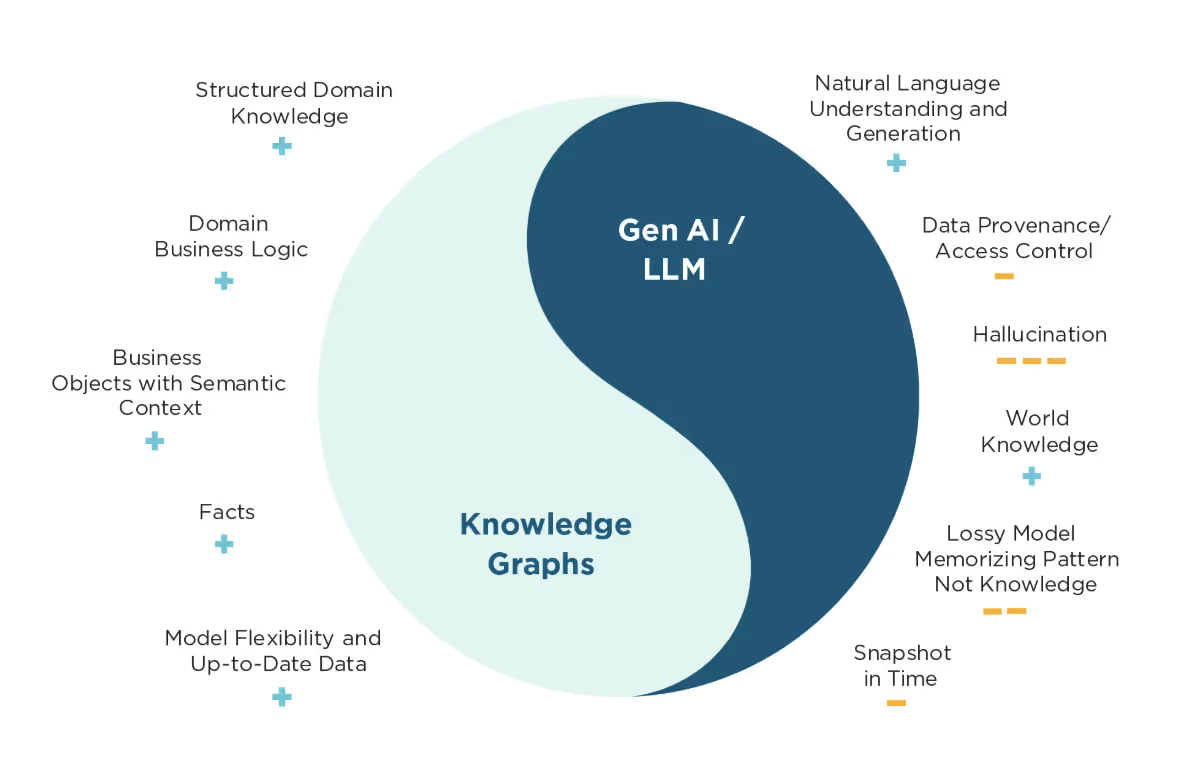
Knowledge graphs constrain LLMs to the most relevant and accurate data, reduce hallucinations, and provide the context needed for agents to plan, act, and reason over real organizational structures rather than abstract document collections. The graph provides, as the same analysis describes, "long-term, persistent memory for agents" that stores facts over time and enables cumulative knowledge and behavior personalization.
Without that layer, an agent is fast and fluent and missing the organizational context that determines whether its outputs are actually useful.
Identity Is the New PageRank
The insight at the center of Atolio's architecture is that enterprise search is not primarily a document retrieval problem. It is an identity and relationship problem. The signal that makes results relevant is not how many other documents link to a document. It is who in your organization cares about it, who has touched it, and how that maps to who is asking the question.
The 762 enterprise interviews conducted before building Atolio confirmed what the architecture already implied: the crown jewels of corporate knowledge flow through people, not links. The most valuable content in any organization is typically the least-linked, the least-indexed, the most sensitive, and the most context-dependent. A keyword index cannot surface it meaningfully. A social graph can.
Enterprise search built on that foundation does something that keyword systems fundamentally cannot: it returns the right result for you, not just a result that contains the right words.